
Home Loan Documents Required in India (2026): Full Checklist
The complete 2026 checklist of home loan documents in India — for salaried, self-employed and NRI applicants, plus the property papers banks actually verify.

Contents
Ask a bank why a home loan file is stuck and you will rarely get a straight answer. Ask a credit manager privately — as we do, regularly — and the answer is almost always the same: the file. Not the borrower's income, not the CIBIL score, not the property's price. Some document is missing, mismatched, or older than the bank's freshness window, and the application sits in a queue while the borrower assumes the bank is "processing."
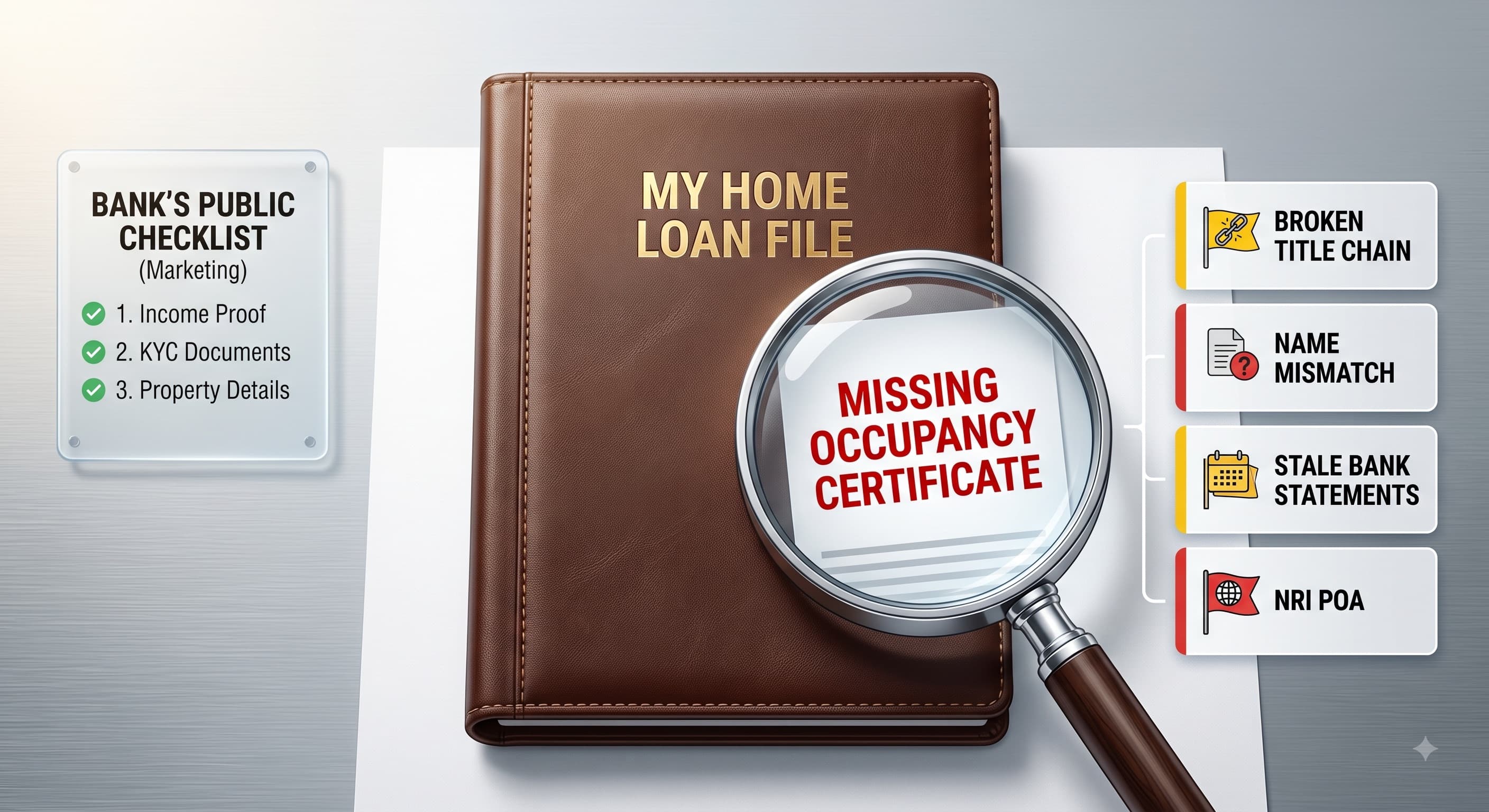
Here is the uncomfortable structure of the situation. The bank knows exactly which documents your file needs. You don't. The list on the bank's website is a simplified marketing version of the real checklist the credit team works from — it says "property documents as applicable" where the credit team means eleven specific papers, three of which take weeks to obtain if you don't already have them. Nobody is incentivised to give you the full list up front, because an intimidating checklist loses customers at the top of the funnel. So borrowers discover the real list one objection at a time, each objection adding a week to a process that should take thirty days.
This guide is the full list. It covers what every lender asks of every applicant, where the big banks differ from each other, what changes if you're self-employed or an NRI, and — the part that actually sinks files — the property documents, organised by the type of purchase you're making. If a term is unfamiliar along the way, our home loan glossary has the plain-language definition.
The four files inside your file
Every home loan application is really four separate document sets, evaluated by different people at the bank:
- The KYC file — who you are. Checked first, mechanically, against government databases.
- The income file — whether you can repay. This is where salaried, self-employed, and NRI applicants diverge completely.
- The property file — whether the asset is worth lending against. Evaluated by the bank's legal and technical teams, and responsible for more delays and rejections than everything else combined.
- The obligations file — what you already owe. Statements of existing loans, and for a balance transfer, a specific set of documents from your current lender.
Banks reject or delay files for weaknesses in any of the four. Borrowers, in our experience, over-prepare the first two and under-prepare the last two.
File 1: KYC — simpler than it used to be
The baseline is set by the RBI's KYC Master Direction and is nearly identical across lenders:
- PAN card (or Form 60 if you don't have one — but for a home loan, get a PAN). This is a tax requirement, separate from identity proof.
- One Officially Valid Document (OVD) for identity and address: passport, driving licence, Aadhaar, voter ID. Aadhaar is the workhorse choice because it doubles as address proof.
- If your current address differs from your OVD: a utility bill not older than two months, a property tax receipt, or an employer accommodation letter works as supplementary proof.
- Passport-size photographs — SBI and Axis still ask for three physical photos on the form.
Two things have genuinely improved since 2024. Most large lenders now run video KYC (V-CIP), which the RBI treats as equivalent to walking into a branch — no in-person verification needed. And DigiLocker-issued e-documents are valid KYC under the RBI's rules, so a phone-stored Aadhaar or driving licence is no longer something a bank can refuse. If a branch officer insists on notarised photocopies of everything in 2026, that's branch habit, not regulation.
One detail that trips up more files than any other: your name must match, character for character, across PAN, Aadhaar, and your bank account. "Prannay K" on one document and "Prannay Kedia" on another is a mismatch that automated systems flag and humans then have to manually clear. If your documents disagree, fix them with the issuing authority before applying, not during the application.
File 2: Income — the salaried checklist
For salaried applicants, the core is the same everywhere:
- Salary slips — last 3 months (ICICI accepts just the latest one; LIC Housing Finance asks for 6).
- Bank statements — last 6 months of the account your salary lands in. SBI goes further and asks for statements of all bank accounts you hold.
- Form 16 — latest, and at SBI, the last two years (or two years of ITRs instead).
- Employer ID card — SBI asks explicitly.
- If you've been in the job under a year: appointment letter or employment contract. If a big chunk of your pay is variable, Axis will want 6 months of payslips and two years of bonus proof rather than three slips.
- Statements for any running loans — typically the last 12 months of repayment track.
A useful way to think about this file: the bank is reconstructing your FOIR — the share of your monthly income already committed to EMIs and obligations — and stress-testing whether the new EMI fits. If you want to see your file the way the credit team will, run the numbers first: our FOIR guide explains the ratio, and the calculator below applies it.
File 2, harder mode: the self-employed checklist
Self-employed applicants carry roughly double the paperwork, because the bank can't outsource income verification to an employer:
- ITRs for 2–3 years — computed and CA-attested, with the computation of income. Most private banks want 2 years; SBI and LIC HFL work on 3. Filed on time, every year — a gap year or a habitually late filing is read as income instability.
- Financial statements — profit & loss account and balance sheet with annexures, CA-sealed, for the same 2–3 years.
- Bank statements — 6 months of all operative accounts, personal and business. (LIC HFL asks for 12.)
- GST returns — last 1 year, now standard at ICICI and most large lenders.
- Business existence proof — registration certificate, shop & establishment licence, or GST registration; for companies and firms, the partnership deed or incorporation documents, MOA/AOA, and lists of directors and shareholders.
- Professionals (doctors, CAs, architects) additionally: qualification and practice certificates — degree, council registration, certificate of practice. SBI folds this into "TDS certificates and professional qualifications as applicable."
The pattern to notice: for the self-employed, the bank is triangulating your declared income across three independent records — ITR, financials, and bank credits, with GST as a fourth check. If the three tell different stories, the bank believes the lowest one. Get your CA to reconcile them before the bank does.
File 2, NRI mode
NRI applicants layer country-of-residence documents on top of the standard KYC:
- Passport and valid visa — the visa establishes NRI status. Gulf-based applicants: work permit or labour card. OCI cardholders: the OCI card.
- Overseas address proof — a recent utility bill or a government-issued document from your country of residence.
- Income documents — employment contract, 3 months' payslips, and the previous year's tax return of your country of residence (commonly waived for Middle East-based and merchant navy applicants, where there is no income tax to document).
- Bank statements on both sides — 6 months of your overseas salary account and 6 months of your Indian NRE/NRO account.
- Power of Attorney — if you won't be in India to execute documents, a POA holder signs for you. Banks have specimen formats; the POA is typically attested at the Indian embassy if executed abroad.
- Some lenders (Axis, notably) ask for an overseas credit report from your country of residence's bureau. Not universal, but don't be surprised by it.
All self-attested, with originals verified by bank officials — or certified by the Indian embassy if you're doing the whole process from abroad.
File 3: Property documents — where files actually die
This is the section to read twice. Income problems get your loan amount reduced; property problems get your file killed, sometimes after weeks of processing. The required set depends on what you're buying.
Buying a resale flat
- Sale deed / title deeds — including the previous chain of ownership. The bank's lawyers trace the title backwards, commonly 13–30 years. A missing link in the chain is the single most common property-side rejection.
- Encumbrance certificate (EC) from the sub-registrar's office, showing the property is free of registered mortgages and claims. Online in most states now; a few hundred rupees and 2–3 working days.
- Occupancy certificate (OC) — for a ready building. A building without an OC is a building the municipal authority hasn't signed off on, and many lenders simply won't touch it.
- Approved building plan and, in society purchases, the share certificate (Maharashtra), latest maintenance bill, property tax receipts, and electricity bill — the boring papers that prove the flat exists in the records and nobody else has a claim on it.
- Agreement to sell and receipts for any payments already made to the seller.
- If the seller has a running loan on the property: the seller's lender's no-dues certificate / loan closure letter. HDFC's own credit team lists a missing seller-side NOC among the top document reasons files stall.
Buying from a builder (ready or under construction)
- Allotment letter and builder-buyer agreement, plus receipts of every payment made.
- The project's approvals: sanctioned building plan, commencement certificate, and the builder's own title documents over the land (development agreement, conveyance).
- RERA registration number of the project — mandatory for virtually any project of meaningful size (over 500 sq m or more than 8 units). Lenders check it; so should you, directly on your state's RERA portal.
- Builder NOC confirming no lien on your specific unit.
- For under-construction purchases, banks disburse in stages against construction progress certificates, and most execute a tripartite agreement between you, the builder, and the bank.
Buying a plot and building on it
The hardest file of the three. Everything from the resale list applies to the land, plus:
- Mother deed — the parent title document, with an unbroken chain, ideally decades deep.
- Conversion certificate — if the land was ever agricultural, proof it's been converted to non-agricultural/residential use. In Karnataka this is the DC conversion; equivalents exist in most states.
- Approved layout plan — and specifically, approved by the right authority. A "panchayat-approved" layout where the city development authority has jurisdiction is a classic trap.
- Khata certificate and extract (Karnataka) — and note that Bengaluru has moved to e-Khata; an A-Khata property is loan-eligible, a B-Khata property mostly isn't.
- Construction estimate from an architect or civil engineer — the bank lends against the plot plus the build cost, and wants the build cost on paper.
- Revenue records, latest tax receipts, and for inherited land, the family tree certificate.
File 4: Balance transfer — the documents your current bank owes you
If you're moving an existing loan to a cheaper lender — the single highest-ROI move most overpaying borrowers can make, as we've argued in the balance transfer guide — the new lender needs everything above plus four documents only your current lender can produce:
- Foreclosure letter — the exact amount to close the loan, with a validity date.
- Loan statement / repayment track record — your EMI history, which is your actual credit story.
- List of Documents (LOD) — an itemised list of every original property document the current lender is holding. The new lender lends against this list, sight unseen, until handover.
- NOC consenting to the transfer.
Here is the practical problem: your current bank has no incentive to produce these quickly, and every incentive to route you to the retention desk instead. Banks are obliged to provide them, but "obliged" and "prompt" are different words. Build a 2–3 week buffer into your transfer timeline for this step alone — and remember that a retention call offering you a lower rate to stay is often the cheapest win available. We covered how to force that conversation in the rate negotiation guide.
The seven document mistakes that stall files
From bank credit teams' own published lists and what we see in audit calls, in rough order of frequency:
- Name/address mismatches across PAN, Aadhaar, and bank records.
- Broken title chain on resale property — a missing link document from a previous transaction.
- Missing OC, or construction that deviates from the sanctioned plan.
- Stale documents — banks treat salary slips and statements as fresh for roughly 90 days; a slow application can expire its own paperwork.
- ITR-bank statement mismatch for self-employed applicants.
- Seller-side loose ends — no-dues certificate from the seller's lender, pending property tax.
- Unregistered agreements — an unregistered agreement to sell has no evidentiary standing, and lenders treat it accordingly.
None of these is fatal. All of them cost weeks precisely when you're racing a rate-lock or a seller's patience.
How to actually prepare
Make three folders — KYC, income, property — before you approach any lender. Scan everything. Verify your name matches everywhere. Pull your own EC and CIBIL report before the bank does, so you find the surprises first (our CIBIL guide covers how to read the report). For resale purchases, ask the seller for the LOD and chain documents at the negotiation stage, not after you've paid a token advance. Sellers who hesitate to produce papers early are telling you something.
And check your realistic loan amount before committing to a property — eligibility surprises after a token payment are expensive:
Where Ekatra fits
Document assembly is the least glamorous part of what we do and, honestly, one of the most valuable. When we run a refinance or balance transfer for a household, we produce the complete document list for the specific lender and the specific property type up front, chase the current lender for the foreclosure letter and LOD, and pre-check the file the way a credit team would — so objections get fixed before submission instead of after. It's free, because our model doesn't depend on lender commissions. If you want your file — or your existing loan — looked at properly, start with the free audit.
Frequently asked questions
How many days does home loan document verification take?
KYC and income verification are typically done in 3–7 working days. Property legal and technical verification takes 1–3 weeks depending on the state and how complete the title chain is. A fully prepared file gets sanctioned in 2–4 weeks; an incomplete one can take months.
Can I get a home loan without Form 16 or ITR?
As a salaried applicant, some lenders will work with salary slips and bank statements alone at the margin, but expect a worse rate and lower eligibility. As a self-employed applicant, no meaningful lender will proceed without ITRs — 2–3 filed years is the entry ticket.
Is Aadhaar mandatory for a home loan?
No. You need PAN plus any one officially valid document — passport, driving licence, voter ID, or Aadhaar. In practice Aadhaar is the most convenient because it covers identity and address in one document and works with video KYC.
What property documents matter most for an under-construction flat?
The project's RERA registration, the sanctioned plan and commencement certificate, the builder-buyer agreement, and the builder's own title over the land. Your bank's legal team checks the builder's paperwork more thoroughly than yours — a project many banks have already approved ("APF-listed") processes much faster.
Do I need to submit original documents?
For verification, yes — originals are sighted and returned. The originals of the property documents, however, stay with the lender for the life of the loan as security, listed in the LOD, and come back to you at closure.
What extra documents does a home loan balance transfer need?
Four, all from your current lender: the foreclosure letter, the loan statement/repayment track, the list of documents (LOD) held, and an NOC for the transfer. Everything else mirrors a fresh application.
Related reading
- The Complete Home Loan Guide for India in 2026
- FOIR Explained: The Ratio That Decides Your Loan Eligibility
- Why Home Loan Applications Get Rejected — and How to Fix Each Reason
- The Complete Guide to Home Loan Balance Transfer in India
- The Home Loan Glossary: every term, in plain language
Ekatra is a free, AI-native home loan management platform built for India's middle-class borrowers. We don't take commissions from lenders — which is why we can tell you exactly what your file needs, chase the documents your bank owes you, and recommend whichever fix actually serves you. Visit joinekatra.com to start the diagnostic for your loan.

Written by
Prannay KediaThe founder of Ekatra, he previously worked at Bain & Company and the Bombay Stock Exchange, holds an MBA from IIM Calcutta, and writes about money and music.