
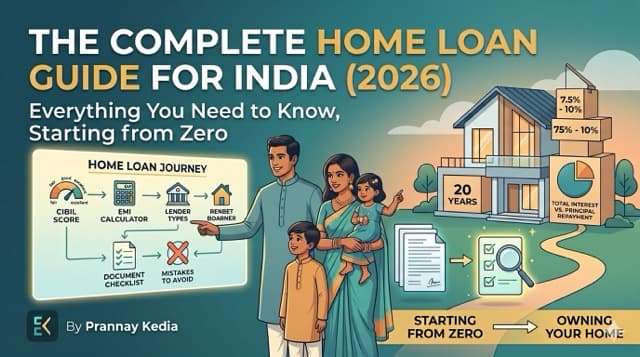
How to Get a Home Loan in India: The Complete 2026 Guide
How to get a home loan in India, start to finish: eligibility, CIBIL, documents, sanction-letter negotiation — and the 10 mistakes that cost lakhs.

Contents
Most middle-class Indians taking their first home loan don't actually know what a home loan is. Not the marketing definition — the operational mechanics. They know it lets them buy a house. They know there's a monthly payment. They know it lasts twenty years. Beyond that, the entire transaction lives in a fog of acronyms, signatures, and small print written in a language that is technically precise and practically incomprehensible.
This guide is the explanation you should have been given the day you started thinking about buying. It assumes you know nothing. By the time you finish reading it, you will understand every term, every step, every document, every negotiation, and every mistake to avoid. Not because home loans are complicated — they aren't, fundamentally — but because nobody has ever sat you down and explained them properly, and the institutions on the other side of the table have no incentive to. Whenever a term trips you up along the way, our home loan glossary has the plain-language definition.
The asymmetry is the product. Closing it takes about ninety minutes of reading and a willingness to ask questions other borrowers don't.
1. What a home loan actually is
A home loan is an arrangement where a bank gives you a large sum of money today — typically between ₹20 lakh and ₹1 crore for middle-class buyers — and you give it back over the next 240 months in equal monthly installments. The bank is not being generous. They are charging you interest. By the time the loan ends, you will have paid them back roughly twice what you borrowed.
A worked example. You borrow ₹50 lakh at 8.5% for 20 years. Your monthly payment, called an EMI, is ₹43,391. Multiply that by 240 months and the total amount you give the bank is ₹1.04 crore. The ₹50 lakh is the loan repayment. The other ₹54 lakh is interest. Just over half of what you give the bank is the price of borrowing.
This is what a home loan is. Everything else — the paperwork, the acronyms, the underwriting, the sanction letter, the disbursement — is detail surrounding this single fact: you are exchanging a large lump sum today for a much larger total payment spread across two decades.
The reason banks are willing to lend such large sums is that the property itself serves as collateral. If you stop paying, the bank can legally take the property and sell it to recover what you owe. This is why home loan interest rates (7.5%-10% in 2026) are dramatically lower than personal loan rates (12%-18%) or credit card rates (36%+). The bank has security. The borrower has obligation. Both sides know that the property is what makes the transaction work.
The reason home loans last twenty years and not five is that the EMI math wouldn't fit middle-class incomes on shorter tenures. A ₹50 lakh loan at 8.5% over five years would be an EMI of ₹1.02 lakh per month — affordable only at incomes above ₹2.5 lakh net monthly. Stretch it to twenty years and the EMI drops to ₹43,000, affordable from ₹1 lakh net monthly. The long tenure is what makes home ownership possible for ordinary salaried buyers. It is also what makes the total interest astronomical.
This is the entire product, in plain language. The remaining sections explain how it is negotiated, structured, applied for, approved, disbursed, and managed.
2. The three numbers that define every home loan
Every home loan is defined by three numbers. Once you understand how they interact, the math stops feeling mysterious.
The principal is how much you borrow. It depends on the price of the property and how much of that price you fund yourself (the down payment). If the property costs ₹80 lakh and you put down ₹20 lakh of your own money, the principal is ₹60 lakh. The bank pays the seller ₹60 lakh directly; you pay ₹20 lakh from your savings. You now owe the bank ₹60 lakh plus interest.
The interest rate is the annual cost of borrowing, expressed as a percentage. In India in 2026, home loan rates range from about 7.50% (the cheapest public sector banks for prime profiles) to 11% or more (housing finance companies for weaker profiles). The rate you receive depends on the bank, your credit score, your income profile, and the loan size. Same property, same buyer, different bank can mean 100 basis points (1 percentage point) of difference. Whether that rate is fixed or floating is a separate decision with its own trade-offs — our fixed vs floating guide covers it in depth.
The tenure is how many years you have to repay. Most home loans run 15 to 30 years. Twenty years is the most common.
These three numbers determine your monthly EMI through a standardised formula. You don't need to memorise the formula. You need to understand the relationships. Before going further, see them for yourself with your own numbers.
Hold rate and tenure constant. Doubling the principal doubles the EMI. Twice the loan, twice the monthly payment.
Hold principal and tenure constant. Higher rate means higher EMI, and significantly higher total interest over the loan's life. On a ₹50 lakh, 20-year loan, the difference between 8.5% and 9.5% is ₹2,800 a month in EMI — but ₹6.7 lakh in total interest paid.
Hold principal and rate constant. Longer tenure means lower EMI but enormously higher total interest. This is the most expensive trick in Indian home lending. Look at a ₹50 lakh loan at 8.5%:
- 15-year tenure: EMI ₹49,237, total interest paid ₹38.6 lakh
- 20-year tenure: EMI ₹43,391, total interest paid ₹54.1 lakh
- 25-year tenure: EMI ₹40,261, total interest paid ₹70.8 lakh
- 30-year tenure: EMI ₹38,446, total interest paid ₹88.4 lakh
Adding ten years to your loan reduces your EMI by ₹4,945 a month and adds ₹49.8 lakh to the total interest you pay. This is not a small number. It is, on most middle-class incomes, more than a year's salary, gone to the bank as interest, in exchange for a marginally lower monthly payment.
Banks pitch longer tenures as "affordability" and "flexibility." The arithmetic says they are profitable for the bank. Pick the shortest tenure you can sustain. The right answer is almost always 15-20 years, not 25-30.
3. How much you should actually borrow is not how much the bank will lend you
When you walk into a bank, they will calculate your "maximum eligibility." That number is the largest loan they're willing to give you — calculated using three internal rules.
The first rule is FOIR (Fixed Obligations to Income Ratio). The bank limits your total debt obligations — including the new home loan EMI plus any existing car loans, credit card EMIs, or personal loans — to 40-55% of your net monthly income. They protect themselves by ensuring you have enough left over after debt service to actually live. We unpack this ratio fully in our FOIR guide.
The second rule is LTV (Loan to Value). The bank will fund only a portion of the property value — usually 90% for loans under ₹30 lakh, 80% between ₹30-75 lakh, and 75% above ₹75 lakh. You must put down the rest as down payment.
The third rule is the income multiple. Most lenders cap loans at 60-72 times your net monthly income, regardless of how the other math works out.
Whichever of the three is lowest sets your maximum. The bank will gladly extend you all the way to that maximum, because more loan principal means more interest income for them. You can estimate that maximum yourself before any bank runs the numbers.
But the bank's maximum is not your right number. The bank is optimising for its risk tolerance. You should be optimising for your life.
The right loan size is the one that leaves you with a 6-12 month emergency fund after the down payment, lets you continue investing for retirement, lets you handle one serious life disruption (job loss, medical emergency, family obligation) without entering debt distress, and still leaves room for the things that make life worth living.
A simple framework I'd give to any first-time buyer: the 33-33-33 rule for total property outlay. Approximately one-third of your total cost goes to down payment, one-third becomes the loan principal, one-third covers closing costs and replenished emergency fund.
For a ₹90 lakh property, that's roughly ₹30 lakh down, ₹60 lakh loan, and ₹25-30 lakh in stamp duty, registration, GST (if under-construction), brokerage, MOD stamp duty, processing fee, immediate furnishing, and rebuilding your liquidity buffer. The bank will tell you that you can borrow ₹72 lakh against this property and put down only ₹18 lakh. They are right that you can. They are wrong that you should. Stamp duty alone varies widely by state, so check what it costs where you're buying.
A second rule, even simpler: total EMIs across all your debt should not exceed 40% of your net take-home pay. The bank allows up to 50-55% because they have collateral protection. You should self-impose 40% because the gap between 40% and 55% is where financially distressed middle-class households live. Most personal financial collapses you read about start with someone whose EMIs were "manageable on paper."
A worked example for the most common middle-class profile. Couple earning ₹1.2 lakh combined net monthly, no existing EMIs, looking at a ₹75 lakh property in Pune. Bank's maximum eligibility: ₹65 lakh over 25 years (EMI ₹52,500, FOIR 44%). The right answer: ₹50 lakh over 18 years (EMI ₹46,000, FOIR 38%). Down payment increases from ₹10 lakh to ₹25 lakh, but you save ₹38 lakh in total interest over the loan's life and you finish paying it off in your mid-career rather than at retirement.
4. There are four kinds of home loan lenders in India, and the right one depends on you
Home loans in India come from four broad categories of lenders. They are not interchangeable. The right choice depends on your profile and what you value.
- Public Sector Banks (PSBs) — State Bank of India, Bank of Baroda, Punjab National Bank, Canara Bank, Union Bank of India, and others. These are government-owned banks. They offer the lowest rates in the market because they have access to cheap retail deposits and run less aggressive cross-selling operations. In 2026, their starting rates are roughly 7.35%-7.85% for prime borrower profiles. The trade-off: processing is slower, paperwork is heavier, branch-level discretion is lower. Best fit: salaried borrowers with complete documentation, clean credit profiles, and at least 30-45 days of patience. SBI alone holds roughly a quarter of the Indian home loan market for a reason — when the process works, the rates are genuinely the best available.
- Private banks — HDFC Bank, ICICI Bank, Axis Bank, Kotak Mahindra Bank, IndusInd, and others. These typically price 25-100 basis points higher than PSBs in exchange for faster processing (often 10-15 days for clean cases), better digital interfaces, dedicated relationship managers, and the entire suite of premium banking services. They also cross-sell aggressively — credit cards, insurance, fixed deposits, mutual funds — which you will need to actively resist. Best fit: borrowers who value speed, have existing banking relationships, and have the discipline to decline the upsell.
- Housing Finance Companies (HFCs) — LIC Housing Finance, Bajaj Housing Finance, Tata Capital Housing, PNB Housing, Aditya Birla Housing Finance, and others. These are specialised lenders regulated by the National Housing Bank and the RBI. Quality varies significantly within this category. The top HFCs operate at private-bank rates with HFC-style flexibility — they're particularly useful for self-employed borrowers whose income narrative doesn't fit a bank's standard templates, or for buyers of properties banks consider higher-risk. The weaker HFCs are subprime lenders charging 10-13%.
- Affordable Housing Finance Companies — Aavas Financiers, Aptus Value Housing, Home First Finance, and similar. These target small loans (₹5-20 lakh) in Tier 3 cities and informal-income borrowers. Higher rates, higher LTVs in some cases, faster underwriting on non-standard income. Usually outside the Ekatra borrower range but useful to know exists.
Beyond the lenders themselves, you will also encounter DSAs (Direct Sales Agents). These are independent intermediaries who source applications for banks and HFCs on commission. Most home loan applications in India still flow through DSAs. They are useful for chasing paperwork and expediting internal approvals. They are not useful for choosing your lender — their incentive is to direct you to whoever pays the highest commission, which is rarely the cheapest lender. Treat a DSA as a project manager, never as an advisor.
The discipline of choosing a lender well runs in three steps. Start with online eligibility checkers from five or six lenders — these use "soft pulls" of your credit report that don't impact your score. Identify the two or three whose rates and fees look genuinely competitive for your profile. Apply formally to those two or three only, because each formal application is a "hard pull" that does impact your score. Compare the resulting sanction letters on all-in cost over the first five years, not headline rate.
5. Your CIBIL score is the most important number you've probably never tracked
CIBIL is short for TransUnion CIBIL Limited, the largest of India's four RBI-recognised credit bureaus. CIBIL maintains a record of your credit behaviour — every loan, credit card, EMI, and missed payment for the past several years — and converts it into a three-digit number between 300 and 900. This is your credit score.
Above 750 is "good." Above 800 is "excellent." Below 650 is where home loan applications start getting rejected at most prime lenders.
The reason banks care so much about this number is straightforward. It is the single best predictor they have of whether you will repay the loan. A borrower with a 780 CIBIL is statistically much less likely to default than a borrower with a 670 CIBIL. The bank prices this risk into your interest rate.
The pricing impact is larger than most first-time borrowers realise. On a ₹50 lakh, 20-year loan, the difference between an 800 CIBIL borrower and a 700 CIBIL borrower at the same lender is typically 50-75 basis points of rate. That's ₹2,200-₹3,500 of EMI difference per month, ₹5-8 lakh of extra interest paid over the loan's life. The same property, the same borrower, three years apart with a credit profile cleanup in between — and the second loan is ₹5 lakh cheaper.
Your score is built from five components, in roughly this order of importance:
- Payment history (about 30-35%): Whether you've paid every credit card bill, every EMI, every loan installment on time, every month, for the past three years. A single 30+ day late payment can cost 30-80 points.
- Credit utilisation (about 25-30%): The ratio of your credit card outstanding to your total credit card limit. Above 30% drags your score; above 70% drags it heavily. Counterintuitively, the fix is often to ask your bank for a credit limit increase, not to pay down faster — a higher limit with the same spending reduces your utilisation ratio.
- Length of credit history (about 15%): Older credit accounts are better. Closing your oldest credit card "to clean up" before applying for a home loan is one of the most common own-goals in Indian personal finance.
- Credit mix (about 10%): Having both secured (home/car loans) and unsecured (credit cards) debt is better than only one type.
- Recent activity (about 10%): Multiple loan or credit card applications in a short window signal credit-hunger and drag the score.
The practical advice for someone preparing to apply for a home loan: pull your CIBIL report at least six months in advance (free annual report from cibil.com). Read every line. Errors are surprisingly common — closed accounts showing as active, payments not posted, late payments wrongly assigned. Dispute errors with the bureau; resolution takes 30-45 days and can lift your score by 30-60 points. Pay every bill on time for six straight months. Keep credit card utilisation under 30%. Don't apply for new credit cards or personal loans. Don't close old credit cards.
Six months of this preparation costs nothing and routinely produces 30-50 CIBIL points of improvement, which translates to 25-50 basis points of rate, which translates to ₹3-7 lakh saved over the life of an average middle-class home loan. It is the highest-return work any borrower can do. For the full playbook, read our CIBIL score guide.
6. The documents you'll need, and the ones that most commonly cause delays
Indian lenders have largely standardised the document list, with minor variations. Have everything ready before you submit the first application, or you will lose two weeks chasing missing paperwork. For the exhaustive version — including NRI and property-type-specific papers — see our complete home loan documents checklist.
If you are salaried, the standard set is:
- PAN card and Aadhaar card (identity and KYC)
- A current address proof — voter ID, passport, utility bill, or registered rental agreement
- Latest three months' salary slips
- Form 16 for the most recent two financial years
- Last six months' bank statements of your salary account
- Income tax returns (ITRs) for the last two years, with the computation pages
- Statements for all existing loans and credit cards (so the bank can calculate your FOIR)
- An employment certificate or appointment letter (sometimes requested)
- Passport-size photographs
- A cancelled cheque to set up the NACH (auto-debit) mandate
If you are self-employed — running a business, practising as a professional, or a partner in a firm — the list is heavier:
- PAN, Aadhaar, and address proof
- Last three years' ITRs with full computation
- Last three years' Profit & Loss statements and Balance Sheets (audited where applicable)
- Last 12 months' bank statements for the business current account
- Last six months' personal savings account statements
- GST returns for the last 12 months, if registered
- Business proof — registration certificate, partnership deed, Memorandum of Association, or professional registration certificate (for CAs, doctors, lawyers)
- Office address proof
- A list of any existing loans or active guarantees
For the property itself, you will need:
- The allotment letter (for under-construction) or sale agreement (for resale)
- The approved building plan
- The chain of title documents for resale properties — sale deed, mother deed, and all intermediate deeds going back 13-30 years
- The latest property tax receipts
- An Encumbrance Certificate showing the property is free of any pending mortgage or legal disputes
- A No Objection Certificate from the housing society (for resale)
- For under-construction: RERA registration certificate, approved layout, and the project's APF (Approved Project Financing) status with major banks
The four most common reasons documentation delays an application:
The borrower hasn't filed their previous year's ITR. If you skipped a year, get it filed first, then apply.
The borrower recently switched salary accounts and doesn't have a clean six months of statements at the new bank. The bank will ask for statements from the previous account too; have those ready.
Aadhaar address doesn't match current address. Update Aadhaar before applying — it can take 30 days.
For resale properties, the chain of title has a missing intermediate deed (a sale or partition that happened twenty years ago whose document wasn't preserved). Reconstructing this through certified copies from the sub-registrar takes weeks and is the single most frequent cause of long delays on resale loans.
Spend the weekend before you apply pulling everything into a single folder — scanned, sorted, clearly labeled. The relationship manager will be quietly impressed and the file will move faster than 80% of comparable applications. Speed in early stages translates to better attention and sometimes better terms.
7. What happens between application and approval
You submit the application form and supporting documents. The form is short. What happens after takes 15-30 days for a clean case and can stretch to 60 for a complex one. Behind the scenes, the lender runs seven checks.
- CIBIL pull. The lender pulls your bureau report. This shows up on your record as a hard inquiry and impacts your score by 5-15 points.
- Income verification. The lender confirms your stated income against the documents you submitted, sometimes by calling your employer's HR department to verify your designation, tenure, and salary. Tampered salary slips are more common than borrowers realise; this verification is partly to detect them.
- Banking analysis. Six months of your bank statements are reviewed for steady salary credits on consistent dates, healthy average balance, EMI debits being honored on time, any cheque bounces, and any anomalous credits or debits. The most common issue: a large unexplained credit (often a "gift" from family) two months before applying, which the underwriter flags as non-verifiable.
- Field investigation. The lender sends a representative to physically visit your stated residence. The purpose is to confirm you actually live there and that the residence appears broadly consistent with your stated income and lifestyle.
- Personal discussion (PD). Either a phone call or an in-person conversation with a credit officer. This is where applications quietly go to die. The officer is gauging stability, intent, and consistency with your documents. Answer professionally and briefly. Don't oversell. Don't lie about anything documentable. If you've changed jobs recently, have a clean factual answer for why. If there's a gap somewhere, have a calm explanation.
- Legal opinion on the property. The bank's panel lawyer examines the title chain, encumbrances, statutory clearances, and the enforceability of the mortgage. Most legal opinions clear in 7-15 days for projects pre-approved by the bank (APF) and take 15-30 days for non-APF cases.
- Technical valuation. The bank's empaneled valuer assesses the property's market value, which sets the LTV ceiling. The valuer's number is usually 10-20% conservative compared to the agreement value — this is how banks protect against agreement inflation. If the valuation comes in much lower than the agreement value, the bank reduces the sanctioned loan amount, and your effective down payment requirement goes up.
The underwriter is not just looking at the numbers individually. They are looking at whether your entire profile tells a coherent story. Salaried borrowers with three years at the same employer, regular salary credits in one bank account, no other active loans, and a CIBIL above 780 are the easy approvals. Everything else requires the underwriter to make a judgment call, and judgment calls go in different directions on different days for reasons the borrower cannot influence.
The borrowers who get the smoothest underwriting are the ones whose documents and statements tell a single, consistent story. The borrowers who struggle are the ones whose pieces contradict each other in small ways, or whose explanations require effort to follow.
8. Why home loans get rejected, and what to do if yours is
In rough order of how often each happens:
- CIBIL below threshold. The most common rejection. Lender minimums are typically 700-720 at prime banks, 650 at some HFCs. Solution: six months of disciplined credit behaviour, then reapply.
- FOIR exceeded. Your existing EMIs and credit obligations leave too little room for the new home loan EMI. Solution: foreclose smaller loans (consumer durable EMIs, personal loans) before applying, or reduce the home loan principal you're requesting.
- Income inadequate for loan size. You're asking for more than your income supports. Solution: add a co-applicant (working spouse, parent), reduce the loan, increase down payment, or wait for a salary increment.
- Recent or unstable employment. Job changes within the last 12 months make underwriters nervous. Solution: wait until you have 12+ months at your current employer with consistent salary credits.
- Property legal or technical issues. Title not clear, project not RERA-registered, building plan deviations, encumbrances on the EC. Solution: change the property, or wait while the seller resolves — which can take months and may not resolve at all.
- Self-employment income volatility. ITRs show declining income, large year-on-year fluctuations, or weak book-keeping. Solution: clean up financials over the next 1-2 years, file consistent ITRs, work with a CA to improve presentation.
- Lifestyle mismatch. Your stated income doesn't match observable lifestyle markers — premium car, expensive area, costly school fees — without supporting income visibility. Solution: depends on whether the income is real but undocumented (then document it through ITRs over 1-2 years) or whether the lifestyle is debt-funded (then unwind that first).
- Bureau red flags. Settled accounts, written-off loans, multiple recent inquiries, ongoing legal disputes against you. Solution: settled accounts often need to be repaid in full and re-reported as Closed; written-offs need active resolution.
- Co-applicant issues. The co-applicant you added has a worse credit profile than yours and is dragging the joint application down. Solution: apply solo or replace the co-applicant.
- Employer blacklist. Some lenders maintain internal lists of "high-risk" employers — companies in financial distress, certain industries, very small private firms. Solution: switch to a different lender; these lists are not industry-wide.
If your application is rejected, do three specific things. First, get the rejection reason in writing — lenders are obligated to provide this on request. Second, do not immediately reapply to other lenders. Each new application is another hard inquiry on your bureau report, and serial rejections in a short window flag you across the entire system. Third, fix the underlying issue and reapply in 3-6 months, preferably at a different lender with a different bureau focus. For a deeper breakdown of each rejection reason and its fix, see why home loan applications get rejected.
9. The sanction letter is the document where everything is locked in. Read it.
If your application is approved, the lender issues a sanction letter — a binding offer that specifies every important parameter of your loan. This document is where your home loan becomes real, and it is the single document most first-time borrowers don't read carefully enough.
The sanction letter typically specifies:
- The loan amount sanctioned (sometimes slightly less than you requested, if the technical valuation came in lower)
- The interest rate and the benchmark it is linked to (the repo rate for most loans in 2026)
- The tenure, in months
- The EMI amount
- The processing fee
- Conditions precedent — what you must do before the loan disburses
- Post-disbursement covenants — what you commit to during the loan's life
- The validity of the offer (typically 3-6 months)
Before you sign, push back on at least four things.
- Processing fee. This is the single most negotiable line item in the entire transaction. Standard charges are 0.25-0.50% of the loan amount, capped variously. On a ₹50 lakh loan, that's ₹12,500-25,000. Ask the relationship manager to waive it or halve it. Banks have internal discretion to do this and routinely grant the waiver, especially during festive periods (Q3-Q4) or when you have a competing sanction in hand. Most borrowers don't ask. Asking takes one sentence and saves real money.
- Interest rate. If you have a sanction letter from another lender at a lower rate, share it. Banks have spreads they can compress at the relationship manager level (typically 10-25 basis points) and additional discretion at the branch head level (another 15-25 basis points). The headline rate on the sanction letter is the start of the negotiation, not the destination. Our rate renegotiation guide shows exactly how to run this conversation.
- Insurance bundling. Many lenders offer a marginally lower interest rate if you agree to a credit-life insurance policy financed by the same lender. The policy is profitable for the bank (they earn high commissions) and almost always worse for you over the loan's life than buying a separate term life policy from an independent insurer. Refuse the bundle and ask for the rate without insurance — in writing, on the sanction letter.
- The pre-payment and foreclosure clause. Per the RBI's Pre-payment Charges on Loans Directions, 2025, applicable to all loans sanctioned from January 2026 onwards, foreclosure charges on floating-rate home loans for individuals are prohibited. Your sanction letter should reflect this. If it doesn't, get it corrected before signing.
Read every other clause. The sanction letter is also where you may find clauses that let the bank unilaterally revise your spread under loosely defined "credit risk" or "market conditions" — push back on these. The processing fee, stamp duty for the MOD registration, legal and valuation costs, late payment penalty structure, and the bank's right to access your other accounts if you default should all be clearly specified.
Once you sign and accept the sanction letter, you are committed. The lender locks in the terms. Disbursement follows.
10. Disbursement, and then twenty years
For a ready-to-move resale property, disbursement is one event. Once all conditions precedent are satisfied (you've paid the processing fee, signed the loan agreement, submitted the original property documents, executed the MOD), the bank issues payment directly to the seller's account — usually as a demand draft or wire transfer — against simultaneous execution and registration of the sale deed at the sub-registrar's office. You then register the Memorandum of Deposit of Title Deeds (which formalises the mortgage), pay stamp duty on it, and the transaction is complete. Your EMIs begin from the next billing cycle.
For an under-construction property, it gets more involved. Disbursement happens in tranches, against construction milestones — typically 20-30% at booking, 30-40% across various stages of construction, 20-30% at handover. During the construction period, which can run 2-4 years, you pay only pre-EMI — interest on the disbursed amount with zero principal reduction.
The pre-EMI trap, said directly: every month of pre-EMI is interest paid with no principal reduction. On a ₹50 lakh loan where 60% is disbursed during a three-year construction window, you'll pay approximately ₹6-8 lakh in pure pre-EMI interest before your formal EMI even begins. Some lenders offer "full EMI from day one" structures, where you pay full EMI based on the total sanctioned amount even during construction. This reduces total interest by a substantial amount but increases your monthly cash burden during construction. For borrowers who can afford it, full EMI from day one is the better choice.
The Occupation Certificate trap is another under-construction issue. Banks disburse the final tranche only against an OC (a municipal certificate confirming the building is constructed per approved plans and is fit for occupation). If the developer delays the OC — common in the post-RERA cleanup of stalled projects — you may have a fully constructed flat that you cannot get final disbursement on, cannot move into legally, and cannot resell easily. Always verify the developer's track record on OC issuance and the expected timeline in the agreement.
The disbursement letter is the final document in the approval process. It confirms the amount disbursed, the payee (seller or developer), the date of disbursement, and the date your EMI commences. Review it before signing. The most common error at this stage is incorrect EMI dates, which can cause the first auto-debit to fail and trigger a bureau impact in your very first month — a needlessly bad start.
After disbursement, the loan settles into routine. Your EMI auto-debits monthly via NACH (the standardised auto-debit system). You receive an annual interest certificate for tax filing. The loan resets quarterly if it's EBLR-linked. You touch it actively only when something goes wrong or you decide to act on it — through prepayment, refinancing, or eventual closure. One thing worth doing in the first year: work out what the loan actually saves you at tax time — under the new tax regime, the honest answer for a self-occupied home is often nothing, as our home loan tax benefits guide explains.
11. Ten mistakes that cost first-time borrowers real money
In rough order of how often each happens and how much it costs:
- Falling in love with a property before understanding financing. Every subsequent decision is now compromised by emotional commitment. Sequence is everything.
- Taking the maximum loan the bank offers. Their maximum is their risk tolerance, not your comfort threshold. Self-impose a 40% FOIR ceiling. The gap between 40% and 55% is where financial distress lives.
- Picking the longest tenure to minimise EMI. The marketing pitches 30-year loans as a feature. The math says they cost you ₹30-40 lakh of extra interest on a ₹50 lakh principal compared to a 20-year alternative.
- Applying to five lenders simultaneously to compare. Five hard inquiries on your bureau report equals 25-50 CIBIL points lost equals worse rate offers from all five lenders than you'd have gotten by approaching them sequentially.
- Accepting bundled insurance because the relationship manager said it was required. It is not required. It is profitable for the bank. Refuse the bundle and get the rate without insurance in writing.
- Skipping the amortisation schedule. The schedule shows, month by month, exactly how much interest you'll pay over 240 months. Borrowers who have not seen this number do not really understand the loan they are taking.
- Not negotiating the processing fee. It is the single most negotiable line item. Most borrowers don't ask. Most lenders waive when asked.
- Lying or fudging on income, employment, or existing debts. Underwriting catches roughly 80% of misrepresentations. Detected misrepresentation doesn't just kill the current application — it gets flagged across the system.
- Buying the home with no emergency fund left over. A home loan plus zero buffer is a loan that is one job loss away from default. Plan for 6-12 months of EMI and household expenses in liquid savings after the down payment is made.
- Forgetting about the loan after disbursement. The loan you ignored is the loan that quietly overcharges you for the next twenty years. Set calendar reminders for reset dates, watch interest rate cycles, plan annual prepayments from bonus income.
The savings from avoiding any one of these can run into lakhs. The savings from avoiding all ten can fund a child's college education.
12. The 240 months after disbursement are when you actually pay for the loan
Most guides stop at disbursement. That's where most of the cost actually starts.
Months 1-3. Confirm your NACH auto-debit is active and the first EMI was correctly applied. The first EMI on a 20-year loan is roughly 85% interest and 15% principal — your outstanding balance reduces by very little. This is normal. It will shift over the years, with principal share rising and interest share falling.
Year 1. Track your reset date (printed on the sanction letter) and mark it on a calendar. Watch the RBI's bimonthly MPC announcements to see whether rates are being cut, held, or raised. Plan to use any festive bonus or annual increment for a small prepayment — even ₹50,000 in year one has outsized impact because of how front-loaded the interest is.
Years 2 through 5. These are the highest-impact prepayment years. ₹1 lakh prepaid in year three saves approximately ₹2.5-3 lakh in interest over the loan's remaining life. The same ₹1 lakh prepaid in year fifteen saves about ₹40,000. Front-load any prepayment capacity.
Year 5 onwards. The refinance window is widest here. If competing offers are 50+ basis points cheaper than what you're paying, refinancing becomes mathematically obvious. Your CIBIL has likely improved over five years of clean EMI payments, which means you've moved up a band and qualify for better rates than you did originally. Whatever rate you sanctioned five years ago is almost certainly worse than what you can negotiate today. When you're ready to evaluate a switch, our balance transfer guide walks through the full math and process.
The boring discipline of monthly maintenance — checking statements, tracking reset dates, evaluating refinance opportunities once every year or two — is what separates the borrowers who pay what they signed up for from the borrowers who quietly overpay for fifteen years. There is no skill involved. There is only the habit of paying attention.
When the final EMI is paid, request a No Objection Certificate from the bank, retrieve all original property documents in person, verify the CERSAI release confirming the bank no longer has a charge on your property, and store the closure paperwork carefully. This is the documentary record that the property is fully yours, unencumbered, free.
How to think about this whole thing
A home loan is not a transaction. It is a twenty-year operating relationship between you and an institution that has a much better idea of how this works than you do. The institution has dedicated underwriting teams, legal templates, valuation panels, recovery infrastructure, and decades of institutional memory. You have a Saturday afternoon and an internet connection.
Most people resolve this asymmetry by trusting the bank to "tell them what to do." That arrangement works fine for the bank. It works less fine for the borrower, in ways that are invisible at sanction and become apparent only ten years in — when you realise you've been paying 150 basis points more than someone with your profile should have, on a loan twice the size you needed, over a tenure twice as long as required.
What works better is sequencing the decision properly. Build your credit profile and savings six to twelve months before you start looking at properties. Set your loan size based on your life, not the bank's risk model. Choose your property knowing the full cost — including the 15-25% beyond the agreement value that won't be financed. Choose your lender on all-in cost over the first five years, not on headline rate. Negotiate the sanction letter before signing it. Manage the loan actively after disbursement.
This is not exotic discipline. It is the same kind of attention any thoughtful person brings to any major decision — except that home loans are taken once, under emotional pressure, with no opportunity to learn from prior attempts. So the attention has to be deliberate and front-loaded.
We built Ekatra because we believe the gap between informed and uninformed borrowers shouldn't depend on whether you happened to read the right guide on the right day. Our calculators handle the analytical parts — eligibility, EMI, full amortisation schedule, total cost of ownership, FOIR sensitivity, refinance break-even, prepayment versus investment trade-offs. The platform is free, runs on your numbers, and doesn't take commissions from lenders.
But whether you use us or not, the principle is the one I'd want anyone in my own family to follow: the home loan is the largest single financial decision most middle-class Indians ever make, and the borrowers who treat it with the seriousness it deserves end up materially wealthier than the ones who don't. The math is not subtle. It is not even hidden. It is sitting in the amortisation schedule, on page eighteen of the sanction letter, in a font that nobody reads.
Read it. Slowly. Before you sign.
That's all it takes.
First-time borrower FAQs
What salary do I need for a ₹50 lakh home loan?
Roughly ₹1 lakh net monthly income, assuming no other EMIs — banks size loans so total obligations stay within 40–55% of net income (FOIR). At ₹75,000 net, eligibility lands nearer ₹35–45 lakh. A working co-applicant raises the ceiling.
What is the minimum down payment for a home loan in India?
RBI's LTV caps set the floor: 10% of property value for loans under ₹30 lakh, 20% for ₹30–75 lakh, 25% above ₹75 lakh. Budget separately for stamp duty, registration and MOD — none of it is financeable.
Can I get a 100% home loan?
No. RBI caps loan-to-value at 75–90% depending on loan size, and banks fund only the agreement value — never stamp duty or registration. Plan for at least 20–30% of the total outlay from your own savings.
How long does home loan approval take?
15–30 days for a clean salaried case at most lenders; up to 60 for self-employed profiles, non-APF projects, or resale properties with title-chain gaps. Documentation readiness is the single biggest factor you control.
What CIBIL score is needed for a home loan?
Most prime lenders want 700–720 minimum; 750+ unlocks the advertised rates and 800+ gets the best pricing. Below 650, expect rejection at banks and 10%+ pricing at HFCs.
Related reading
- The Home Loan Glossary: every term, in plain language
- What is a CIBIL score, and why it decides your rate
- FOIR explained: the ratio that decides your eligibility
- Fixed vs floating interest rates: which to choose
- The home loan balance transfer guide
- How to renegotiate your home loan interest rate
- Why was my home loan application rejected?
Ekatra is a free, AI-native home loan management platform built for India's middle-class borrowers. We don't take commissions from lenders. We help you understand, optimise, and execute every decision in your home loan — from the credit-profile work six months before you apply to the refinance opportunity ten years in. Visit joinekatra.com to run your numbers.

Written by
Prannay KediaThe founder of Ekatra, he previously worked at Bain & Company and the Bombay Stock Exchange, holds an MBA from IIM Calcutta, and writes about money and music.