
What is a CIBIL Score? Meaning, Range & Impact on Your Home Loan
What is a CIBIL score? The 300–900 range explained, what counts as a good score, and how banks use it to set your home loan rate and eligibility in 2026.
Contents
Imagine you walk into a bank to fulfil a life-long dream — buying your first home or starting a business. You’ve got the down payment ready but the bank manager looks at a screen and says, "Sorry, your CIBIL score is too low."
For many Indians, this is where the dream hits a roadblock. If you’ve never heard of CIBIL, don’t worry — you aren’t alone. But in 2026, understanding this number is just as important as knowing your bank account balance.
What exactly is a CIBIL score?
If you are new to the world of finance, think of CIBIL as your Financial Identity Card. CIBIL stands for Credit Information Bureau (India) Limited. It is India’s first and most trusted credit bureau. It collects data from all banks and financial institutions about how you manage your money.
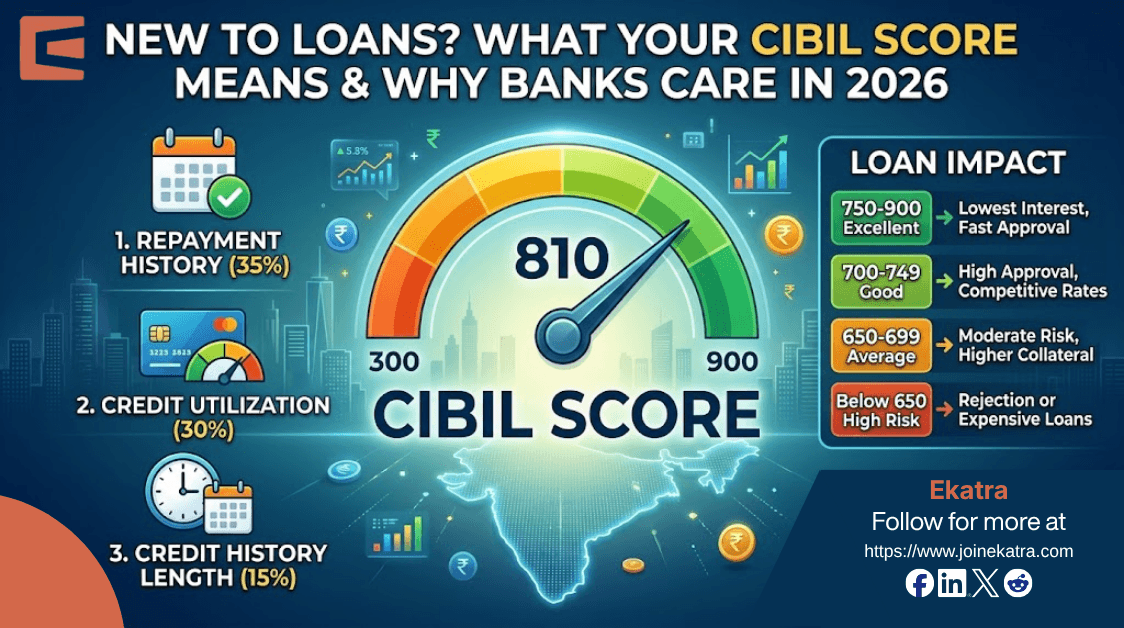
Based on your credit history — your past loans, credit card usage, and repayment patterns — CIBIL gives you a score between 300 and 900.
Essentially, your CIBIL score tells a lender "Is this person responsible? If I lend them ₹10 Lakhs, will they pay it back on time?"
The 2026 CIBIL scorecard: where do you stand?
In India’s rapidly evolving digital economy, lenders are more data-driven than ever. Your score dictates how much you'll pay in interest and how fast you can get approved.
| Score Range | Category | Loan Impact |
| 750-900 | Excellent | Instant approvals, lowest interest rates |
| 700-749 | Good | High approval chances, competitive rates |
| 650-699 | Average | Moderate risk, lenders may ask for higher collateral or interest |
| Below 650 | High Risk | High chance of rejection or very expensive loans |

How your CIBIL score directly impacts your wallet
Recent market research in 2026 shows that lenders are moving toward "Risk-Based Pricing." This means two people applying for the same ₹10 Lakh loan could pay vastly different amounts based purely on their scores.
1. Interest Rates: The "Credit Discount"
A score of 800+ can save you lakhs of rupees over a 20-year home loan. Lenders view high-score borrowers as low-risk and offer them "Prime" interest rates. Conversely, if your score is below 700, you might be charged a 2-4% premium, which adds up significantly over time.
See exactly how your score changes the rate and EMI you'd pay:
2. Faster Approvals & Higher Loan Amounts
In 2026, many Indian banks use automated AI-driven systems for loan processing. If your score is above 750, you might get a "pre-approved" offer with zero documentation. A high score also gives you the leverage to negotiate for a higher loan-to-value (LTV) ratio. Keep in mind, though, that your score is only half the eligibility story — lenders also check your FOIR, the share of your income already going to EMIs.
3. The "Credit Mix" Factor
Lenders now place higher value on a healthy "Credit Mix"—a balance of secured loans (like a car or home loan) and unsecured loans (like credit cards). Showing you can manage both types of debt boosts your credibility.
Top 5 factors that move your score in 2026
According to current financial trends, these factors carry the most weight:
1. Repayment History (35%): Even a single late payment on a credit card or EMI can cause a 50-point dip.
2. Credit Utilization (30%): Using more than 30% of your total credit card limit signals "credit hunger."
3. Credit History Length (15%): Older accounts prove stability. Don't close that 10-year-old credit card!
4. Hard Inquiries: Every time you apply for a loan, a "hard inquiry" is made. Multiple inquiries in a short period can lower your score.
5. Report Accuracy: With real-time reporting now the standard, a single reporting error by a bank can haunt your score. Always check your report for mistakes.
Zero credit history? Here’s how to start
If you’ve never taken a loan, your score might show as "NA" or "-1". This isn't bad, but it makes it hard for banks to judge you.
The Fix? Get a "Secured Credit Card" against a small Fixed Deposit (FD). Use it for small purchases and pay it back in full every month. Within 6 to 8 months, you will have a shining CIBIL score!
In the India of 2026, your CIBIL score is your most valuable financial asset. It’s not just about getting a loan; it’s about getting it on your terms. In conclusion, treat your score like you treat your reputation.
The GOLDEN RULE is to pay on time, keep your debt low, and check your CIBIL report at least once a year to ensure there are no errors. Your future self (and your bank account) will thank you!
Where Ekatra fits
A good CIBIL score is not just an approval ticket — it is negotiating leverage. If your score has climbed since your loan was sanctioned (most borrowers' scores rise after a few years of clean EMIs), you have likely moved up a pricing band — and your bank will not reprice you automatically. Ekatra's free home loan audit checks your current rate against what your CIBIL band should be paying in today's market, and shows whether negotiating with your bank or a balance transfer captures the difference. No commissions, no lender tie-ups.
Frequently asked questions
What is a good CIBIL score for a home loan?
750 and above gets you the best rate bands at most lenders; 700–749 is generally approvable at slightly worse pricing. Below 700, expect rate premiums, lower sanctioned amounts, or rejection — most banks treat 650 as the practical floor for home loans.
How can I check my CIBIL score for free?
CIBIL provides one free full credit report per year at cibil.com, and every RBI-licensed bureau (CIBIL, Experian, Equifax, CRIF High Mark) must give you one free report annually. Many banks and apps also show a free score — fine for tracking, but before a home loan application, pull the full report and check it for errors.
Does checking my own CIBIL score reduce it?
No. Checking your own score is a “soft inquiry” and has no impact. Only “hard inquiries” — made by lenders when you actually apply for credit — affect the score.
How long does it take to improve a CIBIL score?
Meaningful movement takes 3–6 months of on-time payments and lower credit-card utilisation; recovering from a default or settlement takes 12–24 months. Fixing a reporting error is faster — disputes typically resolve within 30–45 days and can restore points immediately.
What is the minimum CIBIL score for a home loan in India?
There is no regulatory minimum — each lender sets its own cutoff. In practice, most banks want 700+, a few lend in the 650–700 band at higher rates, and below 650 approvals are rare and expensive. A higher score doesn’t just get you approved; it directly lowers the rate you’re offered.
My CIBIL score is good but my loan was still rejected. Why?
The score is only the first filter. High FOIR (too much of your income already going to EMIs), unstable employment, property-side document problems, or KYC mismatches can each sink an application independently. Our home loan rejection guide walks through all five.
Related reading
- FOIR Explained: Full Form, Formula & How to Improve Your Loan Eligibility
- Why Was My Home Loan Application Rejected?
- Indian Home Loan Glossary
- Complete Home Loan Guide for India 2026
Ekatra is a free, AI-native home loan management platform built for India's middle-class borrowers. We don't take lender commissions. Visit joinekatra.com to run your numbers.

Written by
Ananya Das