
Home Loan Rejection Reasons in India: 5 Causes & Fixes (2026)
The 5 most common home loan rejection reasons in India — low CIBIL, high FOIR, job instability, document errors — and how to fix each before you reapply.
Contents
You gathered your documents, submitted the application, and waited. Then came the message no one wants: application denied.
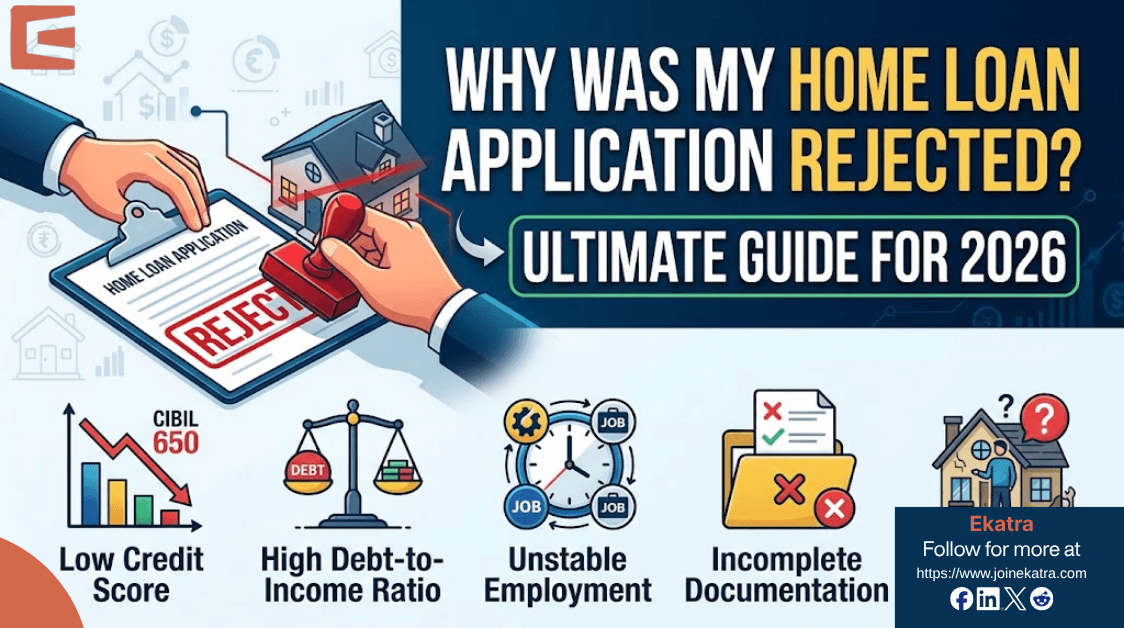
You are not alone. Around 20–25% of home loan applications in India face rejection at some stage — and lenders are not required to tell you why. The five most common home loan rejection reasons in India are a low CIBIL score, high FOIR, unstable employment, too many simultaneous applications, and document or KYC errors. Here is exactly what to do about each before you reapply.
1. Low CIBIL Score
Your credit score is the first filter every lender applies. Missed EMIs, delayed credit card bills, or past defaults all drag it down.
Threshold: Most banks require a minimum CIBIL score of 700–750. Below 650 almost always means rejection.
Fix: Check your credit report for errors — a cleared loan sometimes still shows as active. Pay down outstanding balances and avoid new credit applications for at least 3–6 months before reapplying.
Not sure where your score puts you? See the rate each CIBIL band actually gets:
2. High FOIR (Debt-to-Income Ratio)
Your Fixed Obligation to Income Ratio measures how much of your monthly income is already committed to existing EMIs and bills.
Threshold: Most lenders want your total obligations — including the new loan — below 40–50% of your net monthly income. If you earn ₹60,000 and already pay ₹30,000 in EMIs, expect rejection.
Fix: Close small loans or credit card balances before applying. Even clearing one small debt can shift your FOIR enough to qualify.
Check your FOIR before the bank does:
3. Unstable Employment History
Lenders need confidence you'll have steady income for the next 15–20 years. Frequent job changes or being in a probationary period are red flags.
Threshold: Most lenders require at least 6–12 months with your current employer, or two years of continuous experience in the same industry.
Fix: Wait until you've cleared probation before applying. If self-employed, have at least two years of ITR filings showing consistent income.
Before you reapply, estimate how much loan your income and profile can realistically support:
4. Multiple Loan Applications
Every time you apply for a loan, the lender makes a hard inquiry on your credit report — dropping your score by 10–20 points instantly. Applying to five banks simultaneously signals financial desperation and triggers rejections across all of them.
Fix: Research lenders carefully and apply to one or two that match your profile. If recently rejected, wait 3–6 months before trying again.
5. Document Errors and KYC Mismatches
Sometimes the rejection is purely clerical. Missing salary slips, outdated ITR filings, or name and address mismatches across your PAN, Aadhaar, and bank statements can trigger automatic rejection.
Fix: Before submitting, verify that your name, date of birth, and address match exactly across every document. Have someone else review the application before you send it. And work from a complete list rather than the bank's simplified one — our home loan documents checklist covers every document by applicant and property type, including the property papers that cause most rejections.
Before You Reapply
- Wait 3–6 months for hard inquiries to fade
- Dispute any credit report errors at CIBIL.com
- Clear small debts to bring FOIR below 40%
- Avoid bounced cheques or a savings account that regularly hits zero
A rejection is not a permanent verdict — it is a signpost. Fix the specific issue and your approval chances improve significantly next time.
Frequently asked questions
Does a home loan rejection affect my CIBIL score?
The rejection itself is not recorded in your score — but the hard inquiry the lender made while evaluating you is, and it costs a few points. The real damage comes from reacting to rejection by applying to several more banks at once: each application adds another hard inquiry, and the cluster reads as credit hunger.
How soon can I reapply after a home loan rejection?
Wait at least 3–6 months — enough time for hard inquiries to fade and for whatever caused the rejection (FOIR, score, documents) to actually change. Reapplying immediately with the same profile usually produces the same result plus another inquiry.
Will the bank tell me why my home loan was rejected?
Banks are not obliged to give detailed reasons, and most send a generic letter. You can ask your relationship manager informally — branch staff often know the credit team's objection. Otherwise, reconstruct it yourself: pull your CIBIL report, compute your FOIR, and review the property's papers. The cause is almost always visible in one of those three.
Is the processing fee refunded if my loan is rejected?
Generally no — processing fees are charged for appraising the application, not for sanctioning it. Some lenders collect only a login fee upfront and the balance after sanction. Ask about the fee structure before applying, and factor it into how many banks you apply to.
Can I get a home loan after a previous rejection at another bank?
Yes. Lenders don't share rejection decisions with each other — only the inquiry appears on your report. If you've fixed the underlying issue, a different lender with different credit policies can absolutely approve you. Match the lender to your profile: PSU banks weigh government employment and clean banking heavily; NBFCs and HFCs are more flexible on non-standard income at a higher rate.
Related reading
- What Is a CIBIL Score? Everything Home Loan Borrowers Need to Know
- FOIR Explained: The Ratio That Decides Your Loan Eligibility
- The Indian Home Loan Glossary (2026)
- The Complete Home Loan Guide for India (2026)
- Home Loan Documents Checklist for India (2026)
Ekatra is a free, AI-native home loan management platform built for India's middle-class borrowers. We don't take lender commissions. Visit joinekatra.com to run your numbers.

Written by
Ananya Das