
Is Home Loan Insurance Mandatory in India? The RBI Rules (2026)
No — home loan insurance is not mandatory in India. What RBI rules say about forced bundling, the one insurance banks can require, and when HLPP is worth it.

Contents
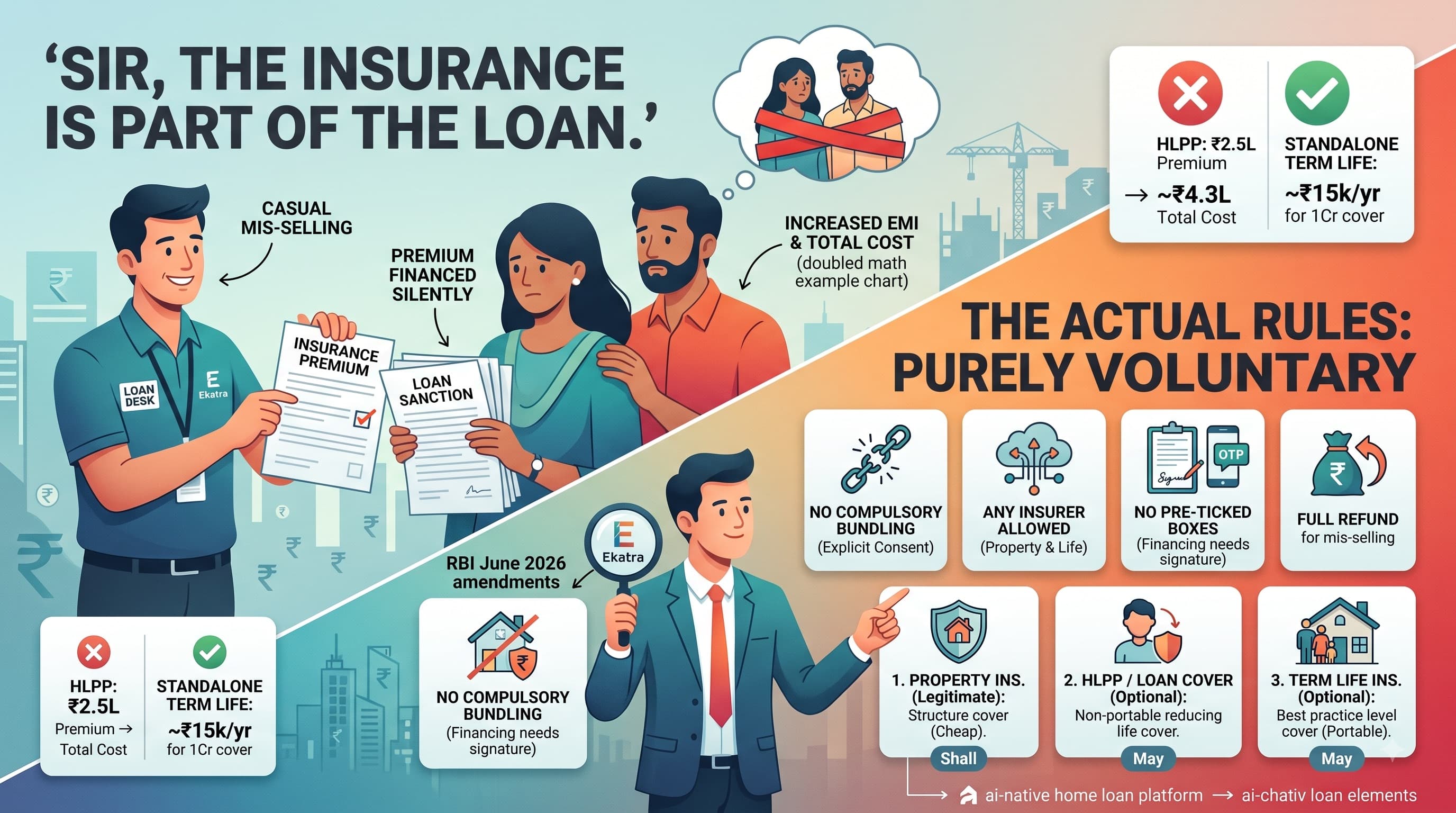
Somewhere between the sanction letter and the disbursement, almost every Indian home loan borrower hears a version of the same sentence: "Sir, the insurance is part of the loan."
It is delivered casually, as procedure rather than sales. Sometimes it's a line item you're asked to sign without discussion. Sometimes the premium has already been added to your loan amount before anyone mentions it. And it works — lakhs of borrowers every year buy a loan-cover insurance policy at sanction believing they had no choice.
They had a choice. No law, no RBI rule, and no IRDAI rule makes home loan insurance mandatory in India. The RBI's own directions say the opposite — in writing, twice, a decade apart. What follows is the actual regulatory position, the one kind of insurance a bank can legitimately require, the real cost of the policy being sold to you, and the narrow cases where buying it is genuinely the right call.
What the rules actually say
The standing rule comes from the RBI's directions on banks' financial services businesses, in force since 2016. The language is not ambiguous. Banks are barred from restrictive practices that force a customer to buy products of a specific insurance company or that link the sale of insurance to any banking product — and the RBI requires banks to state prominently that any insurance purchase by a bank's customer is "purely voluntary, and is not linked to availment of any other facility from the bank."
That phrase — purely voluntary — is the regulator's, not ours. The same language has been on the books since a January 2015 circular on banks' insurance distribution.
And the rules just got sharper. In June 2026, the RBI issued amendments to its Responsible Business Conduct directions, effective January 1, 2027, that go after this exact practice by name:
- Banks may not compulsorily bundle any third-party product — insurance included — with their own products.
- Where insurance genuinely is required as a risk mitigant for a loan, the customer must be allowed to buy it from any provider — not just the bank's partner insurer.
- Banks cannot fund the premium out of the loan without your explicit consent — signed, OTP-verified, or recorded. Pre-ticked boxes are barred, and digital journeys must default to "No."
- Established mis-selling now carries a defined consequence: the bank refunds the entire amount paid, plus compensation under its board-approved policy.
If a bank official tells you insurance is required for sanction, the correct response is polite and specific: ask for that requirement in writing. In our experience, the requirement evaporates at exactly that moment. If it doesn't, the bank's own grievance cell — and after that, the RBI's complaint portal — exists for precisely this.
The one insurance a bank can require — and the two it can't
Part of why this confusion survives is that three different products get blurred into the phrase "home loan insurance." They are not interchangeable.
1. Property insurance (fire/structure cover). This one a lender can legitimately require, because the building is the bank's security. Loan agreements typically require the property to be insured against fire, earthquake, flood and similar risks, with the lender as beneficiary. It is also cheap — structure-only cover costs a few thousand rupees a year even for a large home. Pay it without complaint; from 2027 you can buy it from any insurer you like.
2. Home Loan Protection Plan (HLPP / loan-cover insurance). This is the product actually being pushed at sanction. It's a life insurance policy on you, usually single-premium, where the cover reduces along your loan's amortisation schedule and the payout goes to the bank first. Not mandatory. Never was.
3. Plain term life insurance. A regular term policy, level cover, annual premium, payout to your family — who can use it to close the loan and keep the rest. Also not mandatory, but for most borrowers it is the right way to protect a home loan, as the math below shows.
The tell is in the banks' own fine print. Loan terms and conditions use "shall" for property insurance — and "may" for life and health cover. The banks' lawyers know the difference. The sales desk hopes you don't.
What the bundled policy actually costs you
HLPP pricing has two layers of cost, and the second one is the trap.
Layer one: the premium itself. A reducing-cover HLPP for a ₹50 lakh, 20-year loan for a borrower in their mid-thirties runs in the region of ₹2–2.5 lakh as a single premium. Compare that to plain term insurance: roughly ₹15,000–30,000 a year buys ₹1 crore of level cover for a typical mid-thirties profile — double the cover of the HLPP, non-reducing, with your family as beneficiary.
Layer two: the financing. The single premium is rarely paid from your pocket. It's added to your loan and disbursed to the insurer, which means you pay interest on it for the full tenure. A ₹2 lakh premium rolled into a 20-year loan at 9% adds about ₹1,800 to your monthly EMI and totals over ₹4.3 lakh by the end — financing roughly doubles the cost of the policy. Borrowers routinely discover this only when they notice the disbursement was ₹2–3 lakh short of the sanctioned amount.
Layer three, for refinancers: the policy doesn't travel. Single-premium bundled HLPPs are generally not portable to a new lender. Transfer your loan — the move that saves a typical overpaying borrower several lakh, as we've shown in the balance transfer guide — and the policy either gets surrendered for a fraction of the premium or keeps running, pointed at a loan that no longer exists. The bundled policy is, quietly, a switching cost designed into your loan. We flag this in almost every audit of a loan sanctioned in the last five years.
There's a subtler defect worth knowing even if you never refinance: the reducing cover follows the amortisation schedule computed at inception. If rates rise and your tenure stretches, your actual outstanding can exceed the scheduled cover — leaving your family with a gap at precisely the moment the policy was bought for.
Why the sales pressure exists
It isn't personal, and it isn't about your risk. Insurance distribution is one of the most profitable fee lines Indian banks have. SBI alone earned about ₹2,795 crore in insurance-distribution commission in FY26 — around 85% of it from selling policies of its own subsidiary. Across the banking system, bancassurance generates on the order of ₹25,000 crore a year. The loan officer's incentive sheet has an insurance line on it. Yours doesn't.
This is the same structural pattern we keep returning to on this blog, from rate negotiation to EMI reduction: the products that get pushed hardest at sanction are the ones that pay the bank most, not the ones that serve you best. Regulators have noticed — the finance ministry has publicly said bank mis-selling of insurance adds indirectly to the cost of borrowing, and the January 2027 rules are the direct result.
When loan insurance actually makes sense
An honest guide has to include this part, because for a minority of borrowers the bundled policy is genuinely useful.
- You can't get term insurance. Group HLPP cover comes with simplified underwriting. If diabetes, a cardiac history, age, or a high-risk occupation makes standalone term cover unaffordable or unavailable to you, the group policy may be the only meaningful cover on offer — and some cover on a ₹50 lakh liability beats none.
- You have no cover and won't buy any. If the realistic alternative to the HLPP is nothing, the HLPP wins by default for a single-earner household.
- You want an automatic loan-clearing mechanism layered on top of existing family cover, and you've priced it consciously.
Even in these cases, one rule holds: pay the premium out of pocket if you possibly can. The policy may be defensible; doubling its cost through financing rarely is.
For everyone else — anyone insurable at standard rates — the better structure is boring: a term policy sized to cover the loan plus your family's needs, bought directly, portable across any refinance, with the full sum assured going to your family rather than reducing month by month toward the bank's outstanding.
The decision in four questions
- Is any insurance required for my loan? Property/fire insurance on the structure — yes, legitimately. Life cover — no.
- Am I insurable at normal rates? If yes, term insurance beats HLPP on cost, cover, and portability. If no, the group HLPP earns its place.
- Is the premium being financed? If a premium has been quietly added to your sanctioned amount, ask for it to be removed and pay directly — or decline the policy. From January 2027, financing it without your explicit consent is a rule violation, not a norm.
- Am I likely to refinance? If your rate is above market — check it honestly — a non-portable single-premium policy is a cost you'll eat at transfer time. Factor it into the switching math.
What Ekatra does here
When we audit a home loan, the insurance rider is one of the first things we look for — it's where several lakh of avoidable cost most often hides, right next to an inflated spread. We check whether a premium was financed into your loan, what the policy actually covers today versus your actual outstanding, and whether declining, surrendering, or replacing it with term cover leaves your family better protected for less money. And when we run a balance transfer, we price the insurance question into the switching decision instead of letting it ambush you mid-process. The audit is free, because we don't earn commissions from lenders or insurers — start here.
Frequently asked questions
Can a bank reject my home loan if I refuse insurance?
No. RBI directions bar banks from linking insurance purchase to any banking facility — the purchase must be "purely voluntary." If an officer claims otherwise, ask for the requirement in writing and escalate to the bank's grievance cell if it's actually put on paper (it almost never is).
Is property insurance different from home loan insurance?
Yes, completely. Property (fire/structure) insurance covers the building and can legitimately be required by your lender, since the property is its security. Home loan protection insurance (HLPP) is life cover on the borrower and is always optional.
I already bought HLPP with my loan. Can I cancel it?
Every policy has a free-look period (typically 15–30 days from receiving the policy document) during which you can return it for a refund. Beyond that, single-premium policies can usually be surrendered for a partial value — whether that's worth it depends on the surrender terms, how much cover you'd give up, and whether you have replacement cover in place. Check the surrender maths before acting.
What happens to my HLPP if I transfer my loan to another bank?
Single-premium bundled policies generally cannot be ported to the new lender. You either surrender (usually poor value) or the policy continues against a closed loan. This is worth pricing in before you buy — and it is not a reason to stay on an expensive loan.
Does HLPP give tax benefits?
The premium qualifies under Section 80C like other life insurance premiums — but only within the ₹1.5 lakh cap, only in the year the premium is actually paid, and only under the old tax regime. A financed single premium gives you one year of deduction and twenty years of EMIs on it.
Is term insurance better than home loan insurance?
For anyone who passes standard underwriting, almost always: more cover per rupee, cover that doesn't shrink, payout to your family instead of routed through the bank, and full portability across refinances. The HLPP's advantage is easier underwriting, which matters only if you can't get term cover.
Related reading
- How to Actually Reduce Your Home Loan EMI
- The Complete Guide to Home Loan Balance Transfer in India
- How to Re-negotiate Your Home Loan Interest Rate
- The Complete Home Loan Guide for India in 2026
- The Home Loan Glossary: every term, in plain language
Ekatra is a free, AI-native home loan management platform built for India's middle-class borrowers. We don't take commissions from lenders or insurers — which is why we can tell you honestly when a policy protects your family and when it just protects the bank's fee income. Visit joinekatra.com to start the diagnostic for your loan.

Written by
Prannay KediaThe founder of Ekatra, he previously worked at Bain & Company and the Bombay Stock Exchange, holds an MBA from IIM Calcutta, and writes about money and music.