
How to Reduce Home Loan EMI Without Extending Your Tenure
Real vs cosmetic EMI reduction: how refinancing, rate negotiation, and MCLR-to-EBLR conversion actually cut your home loan EMI — without extending your tenure.

Contents
Most advice on reducing your home loan EMI is, in a literal mathematical sense, designed to make you poorer.
The articles you've read, the calculators you've used, the relationship manager who called you offering to "help" — almost every one of them will quietly route you toward something that does technically lower your monthly payment while increasing the total amount of money you give the bank over the loan's life. They will not lie to you. They will simply not draw the distinction that matters.
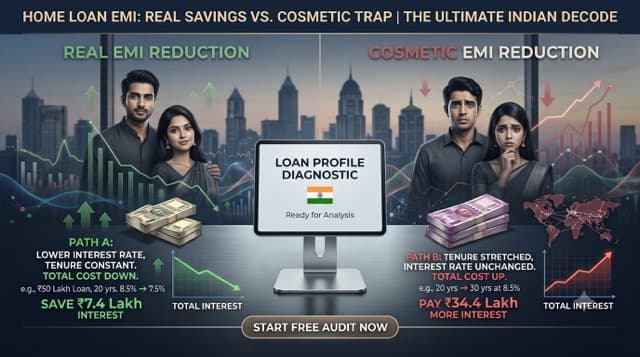
The distinction is this. There are two completely different things being called "EMI reduction" in Indian financial conversation. One is real — your interest rate drops, your monthly payment drops, your total cost drops, you finish the loan on the same date. The other is cosmetic — your interest rate stays the same, your tenure stretches, your monthly payment drops, and you pay the bank substantially more money in total. The first is a financial victory. The second is a financial loss disguised as relief.
This guide is the version of the EMI conversation that nobody in Indian retail finance is incentivised to have with you, because the second version of EMI reduction — the cosmetic kind — happens to be the one that generates the most fees, the most disbursement commissions, and the most reasons to keep you on the bank's books for an extra ten years.
The good news is that the first kind — real EMI reduction — is achievable for most middle-class borrowers. It requires diagnosing why you're paying what you're paying, and matching that diagnosis to one of three specific tools. The rest of this piece is that diagnosis and those tools.
Real EMI reduction vs cosmetic EMI reduction: why this distinction is everything
Take a ₹50 lakh home loan, 20 years remaining, currently at 8.5% interest. EMI today: ₹43,391. Total interest over the remaining life: roughly ₹54.1 lakh.
Now consider two paths a borrower might take to lower their EMI.
- Path A: Real reduction. The interest rate drops from 8.5% to 7.5% — through refinance, rate negotiation, or benchmark conversion. Tenure stays at 20 years. New EMI: ₹40,280. The monthly payment drops by ₹3,111. Total interest paid over the loan's life drops from ₹54.1 lakh to ₹46.7 lakh, a saving of ₹7.4 lakh.
- Path B: Cosmetic reduction. The interest rate stays at 8.5%. The tenure is extended from 20 years to 30 years. New EMI: ₹38,446. The monthly payment drops by ₹4,945. Total interest paid over the loan's life rises from ₹54.1 lakh to ₹88.5 lakh — an increase of ₹34.4 lakh.
Both paths reduce your EMI. The first saves you ₹7.4 lakh of lifetime cost. The second costs you ₹34.4 lakh of lifetime cost. The borrower feels equally relieved by either, because the monthly number went down in both cases. The bank's revenue, however, has moved in radically different directions.
This is the central confusion in Indian home loan content, and it explains why so many articles, blogs, and "comparison calculators" exist that all point borrowers toward the second path. Tenure extension produces no friction for the bank, generates more interest income for the bank, and looks like helpful customer service for the bank. Real rate reduction requires the bank to give up margin. Guess which one gets recommended more often.
For the rest of this piece, when I say "EMI reduction," I mean the real kind — interest rate down, tenure constant, lifetime cost down. The other kind has its place in genuine cash-flow crises, and we'll touch on it briefly at the end. But it should never be your first move, and it should never be presented to you as your only option.
The three tools, the three mistakes, and how they map
Every middle-class Indian home loan borrower paying an unnecessarily high EMI is doing so for one of three reasons. Each reason has a corresponding tool to fix it.
The three mistakes that cause borrowers to pay more than they should:
- You got a bad rate at sanction — wrong lender, weak credit profile at the time, or the market has shifted downward since.
- You got the wrong loan type at sanction — you took a fixed-rate loan when floating would have served you better.
- You got the wrong benchmark at sanction — your loan was sanctioned before October 2019 and is still linked to MCLR rather than EBLR, which means rate cuts have been transmitted to your loan slowly and partially.
The three tools to fix these mistakes:
- External refinance (also called balance transfer): move the loan to a new lender at a lower rate. Best for: large rate gaps where your existing bank refuses to negotiate, or where you also want to escape a difficult lender relationship.
- Internal rate negotiation: ask your existing lender to reduce your spread without moving banks. Best for: situations where your bank has retention incentives and you have leverage (competing offer, improved CIBIL, documented rate gap).
- Internal conversion: a formal product offered by your existing lender to change a structural feature of your loan — fixed to floating, MCLR to EBLR — for a one-time conversion fee, with no need to move banks. Best for: structural mismatches in loan type or benchmark.
The mapping is not one-to-one. A bad rate (Mistake 1) can usually be addressed with either refinance or rate negotiation, and we'll explore which to pick when. A wrong loan type (Mistake 2) requires internal conversion in most cases. A wrong benchmark (Mistake 3) also requires internal conversion, but it is a different conversion product from the fixed-to-floating one and is processed differently.
What follows is each mistake walked through in detail, with the math, the mechanics, the lender-specific quirks, and the decision framework for which tool to use. If a term along the way is unfamiliar — MCLR, EBLR, spread, benchmark — our home loan glossary has the plain-language definition.
Mistake 1: You got a bad rate at sanction. Refinance or renegotiate.
This is by far the most common reason Indian borrowers are overpaying on their home loans. The category includes three distinct sub-situations, each with slightly different fixes.
Sub-situation A: You went to the wrong category of lender.
Indian home loans come from four broad categories, and they price very differently for the same borrower. In rough order of how cheap they are:
- Public sector banks — SBI, Bank of Baroda, PNB, Canara, Union Bank — currently anchor the bottom of the market at 7.35%-7.85% for prime profiles. They get the cheapest deposits (retail savings accounts that pay 2.7-3%), they have less aggressive cross-sell, and they generally give the same borrower a better rate than any private lender will.
- Top private banks — HDFC, ICICI, Axis, Kotak — typically price 25-100 basis points above PSU rates. The trade-off is faster processing, better digital experience, more flexibility for non-standard profiles.
- Top-tier housing finance companies (HFCs) — LIC Housing Finance, Bajaj Housing Finance, Tata Capital, PNB Housing — usually match top private banks or run 25-50 bps higher. They are particularly competitive for self-employed borrowers whose profile doesn't fit standard bank templates.
- NBFCs and weaker HFCs — the bottom of the market, often charging 10-13% for borrowers who couldn't get approved elsewhere, or who took loans through a builder's preferred lender without comparison-shopping.
The single most common path to a bad rate at sanction is this: the borrower was buying a flat in a project where the builder had tied up with an NBFC or weaker HFC. The DSA on-site recommended that lender because the DSA was getting paid commission. The borrower, deep in the emotional process of buying a home, accepted the recommendation without checking whether their CIBIL profile would have qualified them for an SBI or HDFC loan at 200 basis points lower. Five years later, they are still on that loan, paying 10.5% when they could be paying 8%.
The fix is straightforward: refinance to a better lender. The all-in switching cost (processing fee, MOD stamp duty, legal and valuation charges) on a ₹50 lakh refinance typically runs ₹35,000-70,000. The savings from moving 200 bps of rate is roughly ₹15-20 lakh of interest over the loan's remaining life. The math is brutal in favour of switching. Run the numbers on your own loan before deciding.
Sub-situation B: You had a low CIBIL at sanction.
Banks price risk into rate. A borrower with a 720 CIBIL at sanction may have received a rate that was 50-75 bps higher than what a 800 CIBIL borrower would have gotten from the same bank, for the same loan, on the same day. Over 5-7 years of clean EMI payments, your CIBIL has almost certainly improved. You now qualify for the better rate band, but no bank is going to proactively reprice you.
The fix is either renegotiation with the existing bank (cite the CIBIL improvement, request a spread reduction) or refinance to a new bank where you'll be priced for who you are today rather than who you were five years ago. Renegotiation is usually faster and free; refinance is more reliable but more expensive.
Sub-situation C: The market has shifted and your bank hasn't fully passed it through.
Across 2025, the RBI cut the repo rate by 125 basis points. By the central bank's own published data, banks have transmitted about 89 bps on fresh loans and 87 bps on existing loans. The 36 bps gap is real money — roughly ₹1.4 lakh of interest you'll pay on a ₹50 lakh loan that the policy rate said you shouldn't have to.
The fix is rate negotiation. Your bank is well aware they haven't fully passed through the cuts. The retention desk is set up precisely to handle borrowers who notice this and complain. A polite, specific email to your relationship manager citing the transmission gap, attaching a competing offer if you have one, and asking for a spread reduction will usually produce a 25-50 bps rate cut within two weeks. We covered this in detail in our rate negotiation guide.
Which tool to use — refinance or renegotiate?
Renegotiate first when: your CIBIL has improved meaningfully since sanction, your bank has functional retention processes (most major banks do), and you have a competing offer in hand for leverage. The fix is free, takes 2-3 weeks, and avoids the friction of switching lenders.
Refinance when: renegotiation has failed, the rate gap is large (75+ bps), or you want to escape your current lender for service reasons. The fix costs ₹35,000-70,000 in switching costs and takes 30-45 days, but it forces a clean reset. Our balance transfer guide covers the full process end to end.
The honest sequence for any borrower facing Mistake 1: try negotiation first, refinance only if negotiation fails. In our experience with audit calls, 60-70% of borrowers who would otherwise refinance can get most of the rate improvement through negotiation alone, at a fraction of the cost and friction.
Mistake 2: You took a fixed-rate loan. Convert to floating.
This mistake has become more common in recent years because Indian banks have aggressively pushed "TruFixed," "Fixed-Cum-Floating," and similar branded products that lock in a fixed rate for the first 2-5 years before automatically converting to floating. Borrowers, especially first-time buyers spooked by rate volatility, signed up. Many are now realising they're paying a 150-200 basis point premium for the privilege of "rate certainty" that the floating-rate market would not have demanded.
A worked example. Current floating rates from major lenders for prime profiles in mid-2026 are roughly 7.50-8.00%. Current fixed rates (where genuinely available for the full tenure) are 9.50-10.50%. The fixed-rate premium is 150-200 bps. On a ₹50 lakh, 20-year loan, that premium translates to ₹14-29 lakh of extra interest paid over the loan's life, depending on how floating rates evolve. The borrower paid this premium to avoid rate fluctuation. The fluctuation that has actually happened — RBI cutting 125 bps across 2025 — would have benefited them on a floating loan and is invisible to them on a fixed one. Our fixed vs floating guide covers this trade-off in full.
The fix is internal conversion from fixed to floating. This is a formal product offered by every major lender. The mechanics are well-defined.
- The conversion fee is typically capped low. HDFC Bank charges a maximum of ₹3,000 for fixed-to-floating conversion on certain products; on housing loans, the conversion fee is 0.25% of principal outstanding or ₹5,000, whichever is lower. SBI's analogous fee structure runs ₹2,000-10,000 for full conversion. ICICI and Axis are in similar ranges. The fee is structured low because the RBI has, since August 2023, required lenders to offer this option transparently at every rate reset — and a punitively high conversion fee would invite regulatory attention.
- The process is mechanically simple. You write to your branch manager and relationship manager requesting the conversion, citing the relevant clause from your sanction letter and the August 2023 RBI Master Direction on resets of floating interest rates. The bank's policy will require you to fill a one-page form, pay the conversion fee, and accept a fresh schedule with the revised rate. Total elapsed time: typically 7-15 days.
- The math, plainly. On a ₹50 lakh outstanding with 15 years remaining, converting from a 9.75% fixed rate to a 8.25% floating rate reduces your EMI from approximately ₹52,950 to ₹48,540 — a monthly drop of ₹4,410, and a total interest saving of roughly ₹7.9 lakh over the remaining tenure. The conversion fee, even at the higher end of ₹10,000, is repaid in under three months.
- The right time to do this. Whenever the floating rate at your bank is meaningfully lower than your fixed rate, the math favours conversion. The narrow case where you should not convert is if your fixed-rate period has fewer than 6-12 months remaining (after which it automatically converts to floating anyway), or if you genuinely believe rates will rise sharply soon — which, in mid-2026 with the RBI in a neutral-to-easing stance, is hard to argue.
- A note for borrowers on HDFC's TruFixed or similar hybrid products. Read the sanction letter carefully. Many of these products convert to floating automatically at the end of the fixed period. You may already be on floating without realising it. In that case, your problem isn't loan type — it's likely a rate or benchmark issue, and the fix is different.
Mistake 3: You're stuck on MCLR. Convert to EBLR.
This is the single most underdiscussed expensive mistake in Indian home loan finance, and it affects an enormous number of borrowers who took loans before October 2019.
To recap the history briefly. From April 2016 to October 2019, banks linked floating-rate home loans to MCLR — the Marginal Cost of Funds-based Lending Rate. MCLR is calculated by each bank internally, based on their own cost of funds. Banks have substantial discretion over MCLR calculation. In practice, this discretion got used to slow-walk the transmission of RBI rate cuts to existing borrowers.
In October 2019, the RBI mandated that all new floating-rate retail loans be linked to an external benchmark — typically the repo rate, occasionally a T-bill yield. This regime is called EBLR (External Benchmark Lending Rate), or RLLR (Repo-Linked Lending Rate) when the benchmark is specifically the repo rate. EBLR transmits RBI rate changes faster and more transparently because banks cannot fudge an external benchmark the way they can an internal one.
The consequence is that two borrowers at the same bank, with identical profiles, identical loans, identical CIBIL scores, can today be paying rates that differ by 100-150 basis points — purely because one took the loan in September 2019 (MCLR-linked) and the other in November 2019 (EBLR-linked). The pre-October-2019 borrower has been quietly subsidising the bank's net interest margin for the better part of seven years.
The actual size of the gap. As of mid-2026, SBI's MCLR ranges from 7.85% (overnight) to 8.80% (3-year), with most home loans linked to the 1-year MCLR at 8.70%. Add the typical spread of 165 bps over MCLR and the effective rate is 8.95-10.35%. By contrast, SBI's EBLR-linked home loans start at 7.50% for prime profiles. The gap is 100-150 basis points for the same borrower at the same bank on the same product.
On a ₹50 lakh outstanding with 12 years remaining, that gap translates to roughly ₹4-7 lakh of extra interest paid over the remaining loan life. Not in dispute. Not theoretical. Sitting on the borrower's amortisation schedule today.
The fix is internal conversion from MCLR to EBLR. This is a formal product at every major bank, distinct from the fixed-to-floating conversion. The fee is small.
At SBI, the conversion fee is 0.25% of the outstanding amount, capped at ₹10,000, with a minimum of ₹2,000 plus GST. At HDFC, the fee is 0.25% of principal outstanding or ₹5,000, whichever is lower (for fully disbursed loans). PSU banks generally are in the ₹5,000-15,000 range. The process is: written application to your branch, fill the standard form, pay the fee, the bank recomputes your rate using the current external benchmark plus a fresh spread, and your EMI reflects the new rate from the next billing cycle.
The reason borrowers don't do this. Three reasons, all bad ones. First, no one tells you that you're on MCLR — you have to read your sanction letter or quarterly statement to find out, and most borrowers don't. Second, the banks don't proactively recommend the conversion because they are quietly profitable on the MCLR back-book. Third, the conversion is one of those formal products that requires a branch visit and a form, which feels disproportionate compared to the perceived benefit until you actually do the math.
The math, as we've established, comfortably justifies the friction.
A nuance worth flagging. When you convert from MCLR to EBLR, the bank assigns you a new spread over the external benchmark. This spread is determined by your current CIBIL, current profile, current loan-to-value ratio. If your profile has materially improved since sanction, you may capture additional rate reduction beyond just the benchmark change. Conversely, if your profile has deteriorated, the new spread may partially offset the benefit. In practice, for borrowers with 3+ years of clean EMI payments, the new spread is almost always more favourable than the legacy one.
The RBI 2023 directive that's relevant here. Per the RBI's August 2023 Master Direction on Reset of Floating Interest Rate, lenders are required to give borrowers the option, at every rate reset, to switch from one floating-rate regime to another, and to disclose the costs transparently. You don't need the bank's blessing to ask for this conversion — they are required to offer it.
The RBI 2023 reset right that almost no borrower exercises
There's a fourth mechanism that's worth knowing about, even though it doesn't fit neatly into the three-mistakes framework. It's not a fix for a mistake at sanction — it's a recurring right that almost every Indian floating-rate borrower has and almost none of them use.
Under the RBI's August 2023 Master Direction, lenders are required, at every reset of your floating-rate loan, to inform you of the change and to offer you the following options: continue on floating with the new rate, switch to fixed (if available at the lender), increase the EMI rather than extending tenure, or extend tenure rather than increasing EMI. The bank's default — done silently in most cases — is to extend the tenure rather than adjust the EMI, because extending tenure is operationally easier and quietly more profitable.
Most borrowers never receive the explicit communication about these options because banks comply with the letter of the regulation by burying the notice in a quarterly statement nobody reads. The borrower's right is real but unexercised.
The practical implication: at every reset (typically quarterly), you have the right to write to your bank and specifically request an EMI reduction rather than tenure adjustment, in light of any rate cut your loan has received. The bank is required to consider and respond to this request. Most won't volunteer the option; almost all will honour it when explicitly asked.
This is the rare lever in Indian retail finance that costs nothing, requires no conversion, no refinance, no negotiation, no fees — just a written request at the right time. The reason almost no one uses it is the same reason almost no one negotiates their rate: nobody is paid to tell them they can.
When cosmetic EMI reduction is actually the right call
I've spent most of this piece arguing against cosmetic EMI reduction — tenure extension, prepayment with EMI-reduction option — on the grounds that it increases your lifetime cost of borrowing. If you're weighing a prepayment, compare the tenure-reduction and EMI-reduction options before choosing.
That framing is correct as a default. There are two narrow situations where the cosmetic version is genuinely the right move.
The first is a real cash-flow crisis. If a job loss, medical emergency, or income disruption has temporarily compressed your disposable income, extending the tenure to reduce the EMI is a legitimate tool for surviving the immediate period. The lifetime cost goes up, but the alternative is default, which goes up by considerably more. In these cases, tenure extension is a bridge, not a strategy. Restore to the original tenure when the crisis passes by raising the EMI again.
The second is a deliberate cash-flow optimisation where the freed-up money is being put to a higher-return use. If you can extend your home loan tenure and redirect the EMI savings into an equity SIP with a sustained 12%+ expected return, the math may favour cosmetic EMI reduction over the long arc. This is the "home loan as cheap leverage" framing — borrow long at 8.5%, invest at 12%, capture the spread. It is mathematically valid but operationally hard, because most borrowers who free up EMI through tenure extension end up spending the savings rather than investing them. If you cannot credibly commit to investing the difference, this play is not for you. The prepay-versus-invest trade-off is worth running with real numbers rather than assumptions.
Outside these two situations, cosmetic EMI reduction is a financial loss in the costume of relief.
A simple decision framework
For any middle-class Indian borrower wondering whether their EMI can be reduced and how, the right diagnostic sequence is:
Step 1: Pull your sanction letter and identify the benchmark. If it says MCLR or RLLR (sanctioned pre-October 2019), you have Mistake 3, and an MCLR-to-EBLR conversion at your existing bank is almost certainly the right first move.
Step 2: Check the rate type. If your loan is on fixed or a hybrid fixed-cum-floating product currently in its fixed period, and the prevailing floating rate is materially lower, you have Mistake 2, and a fixed-to-floating conversion is the move.
Step 3: Benchmark your rate against the market. Look up your bank's current advertised home loan rate for fresh customers with your CIBIL profile. Compare to what you're paying. If the gap is 75 basis points or more, you have Mistake 1. Try rate negotiation with your existing bank first, escalating to retention if needed. Refinance only if negotiation fails to close at least 60-70% of the gap.
Step 4: At every reset, explicitly request EMI reduction over tenure adjustment. This is a free, recurring lever that requires only an email.
Apply this sequence in order. Don't refinance before checking the benchmark. Don't pay a conversion fee before negotiating spread. Don't accept tenure extension as a substitute for any of the above.
What Ekatra does, and why we can do it for free
We run this exact diagnostic — for free, on every loan brought to us — and execute the right fix end to end. We pull your sanction letter, identify which of the three mistakes (or which combination of them) applies, benchmark your rate against the current market for your specific profile, and tell you which of the three tools is the right one.
If it's a rate negotiation, we run that on your behalf — sourcing a competing offer, writing the case, escalating through the bank's retention desk, getting the new rate confirmed in writing. If it's an internal conversion (MCLR to EBLR or fixed to floating), we prepare the application, calculate the precise economic case, and walk the file through to completion. If it's a full refinance, we run that too — comparing lenders, negotiating processing fee waivers, coordinating documentation, executing the MOD transfer.
We're free because our revenue model is built around long-term financial management for middle-class households, not transactional commissions. We don't take referral fees from lenders, which is why we can recommend that you stay at your current bank when that's the right call. The three competitors we're often compared to — BankBazaar, Paisabazaar, and the army of DSAs — cannot offer this service because their revenue depends on getting you to switch. We can, because ours doesn't.
The structural insight isn't that the existing players are bad. It's that nobody in Indian retail finance has built a business model around telling borrowers, honestly, that the right move is often to stay put with a cheaper internal product. That gap — between what the market sells and what the borrower actually needs — is where Ekatra exists. If you want the diagnostic run on your own loan, start your free audit.
The reframe
Reducing your EMI is not the goal. Reducing the total cost of your home loan is the goal. Usually these align — a lower interest rate produces both a lower EMI and a lower lifetime cost. Sometimes they don't — tenure extension produces a lower EMI and a higher lifetime cost.
The Indian financial content ecosystem has spent a decade conflating the two, because the entities producing the content are paid more when borrowers take the cosmetic path. Tenure extensions generate no resistance. Refinances generate disbursement commissions. Internal conversions to cheaper products produce nothing for anyone except the borrower.
If your EMI feels high, the correct first question is not "how do I lower the EMI." It is "why am I paying the rate I'm paying, and which of the three structural mistakes from sanction is responsible for it." Answer that question honestly, apply the matching tool, and the EMI reduction follows as a consequence rather than as a manipulated end in itself.
The borrowers who do this come out 5-15 lakh ahead over the loan's life. The borrowers who chase EMI reduction without diagnosis end up with smaller monthly payments and meaningfully larger lifetime bills.
Diagnose first. Reduce after.
EMI reduction FAQs
How can I reduce my home loan EMI without extending the tenure?
Cut the rate, not the schedule. The three real levers: negotiate your spread with your existing bank, convert an MCLR-linked or fixed-rate loan to the cheaper regime, or refinance to a lower-rate lender. Each drops the EMI while the loan still ends on the same date.
Does prepayment reduce the EMI or the tenure?
Your choice — the bank will ask (or quietly default to one). Tenure reduction saves far more total interest; EMI reduction eases monthly cash flow. Run both options through a prepayment calculator before deciding, and put your choice in writing.
What does an MCLR to EBLR conversion cost?
Typically 0.25% of outstanding, capped low: about ₹10,000 at SBI, ₹5,000 at HDFC, ₹5,000–15,000 at most PSU banks. Against a 100–150 bps rate gap, the fee is usually recovered within two or three months.
Can I ask my bank to lower my EMI after a rate cut?
Yes — and it is your right. Under the RBI's August 2023 Master Direction, at every reset your bank must offer you EMI reduction rather than silent tenure adjustment. Almost no borrower asks; almost every bank honours it when asked in writing.
Related reading
- The Complete Home Loan Guide for India in 2026
- How to renegotiate your home loan interest rate
- The home loan balance transfer guide
- Fixed vs floating interest rates: which to choose
- The Home Loan Glossary: every term, in plain language
Ekatra is a free, AI-native home loan management platform built for India's middle-class borrowers. We don't take commissions from lenders — which is why we can run the diagnostic honestly and recommend whichever fix actually serves you, including the ones that don't generate revenue for anyone. Visit joinekatra.com to start the diagnostic for your loan.

Written by
Prannay KediaThe founder of Ekatra, he previously worked at Bain & Company and the Bombay Stock Exchange, holds an MBA from IIM Calcutta, and writes about money and music.