
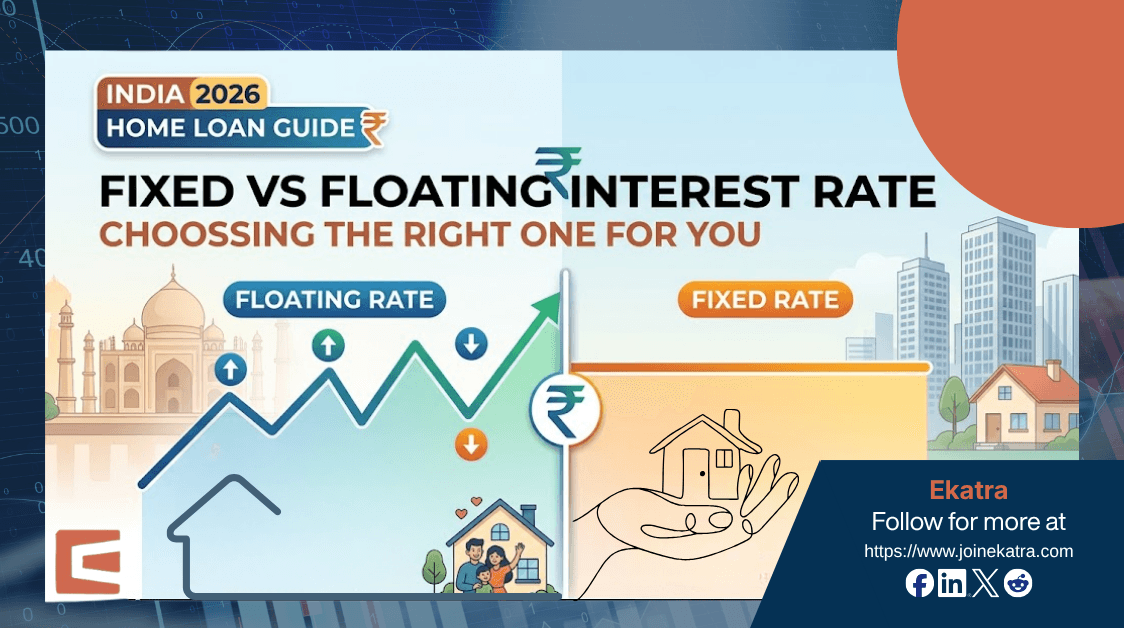
Fixed vs Floating Interest Rate for Home Loans in India (2026)
Fixed vs floating home loan interest rates in India (2026): rate ranges, prepayment rules, a side-by-side comparison, and which one fits your profile.
Contents
Choosing between a fixed and floating interest rate on your home loan is one of the most important financial decisions you'll make. Get it right and you could save lakhs over your loan tenure. Get it wrong and you'll be paying for it — literally — for 20 years.
The short answer: floating rates suit most Indian borrowers in 2026 — they start 1–2% lower and now carry zero prepayment penalties — while fixed rates buy EMI certainty at a premium. Here is everything you need to know to make the right call.
What Is a Floating Interest Rate on a Home Loan?
A floating interest rate changes periodically because it is linked to an external benchmark — most commonly the RBI Repo Rate through the External Benchmark Lending Rate (EBLR) system.
How it works: When the RBI revises the repo rate, your lender adjusts your interest rate accordingly. This typically results in a change to either your EMI or your loan tenure.
Floating rate range in 2026: Approximately 7.5% – 8.5% for eligible borrowers (750+ CIBIL score, salaried).
Key 2026 update: As of January 1, 2026, RBI guidelines strictly prohibit prepayment penalties on all floating-rate home loans. You can now pay off your loan early — using a bonus, inheritance, or savings — with zero extra charges.
What Is a Fixed Interest Rate on a Home Loan?
A fixed interest rate remains the same for a specified period or the entire life of the loan, regardless of what happens in the market.
How it works: Your rate is locked in at the time of disbursement. Your EMI stays the same whether the RBI cuts rates or raises them.
Fixed rate range in 2026: Approximately 8.2% – 9.5% — typically 1–2% higher than floating rates.
Important catch: If market rates fall significantly, you won't benefit. Additionally, fixed-rate loans often carry prepayment or foreclosure charges — check your loan agreement carefully.
Fixed vs Floating Home Loan: Quick Comparison
| Feature | Floating Rate | Fixed Rate |
|---|---|---|
| Interest Rate (2026) | 7.5% – 8.5% | 8.2% – 9.5% |
| EMI Stability | Fluctuates with market | Constant and predictable |
| Prepayment Penalty | Nil (RBI mandated) | May apply |
| Benefits from RBI Rate Cuts | Yes — immediately | No |
| Best For | Long-term borrowers, flexible budget | Tight budgets, short-term loans |
Want to see the actual rupee difference between the two options for your loan amount and tenure? Run your own numbers.
Which Is Better: Fixed or Floating Rate in 2026?
The honest answer: it depends on your financial profile. Here is a straightforward breakdown.
Choose a Floating Rate If:
- You want the lowest possible EMI today. Floating rates almost always start lower, giving you more breathing room in your monthly budget.
- You plan to prepay the loan. With zero prepayment penalties under the new RBI rules, you can use any lump sum to reduce your principal whenever you like.
- You have a long tenure (15–20 years). Over a longer period, rate fluctuations tend to average out in your favour.
- You believe interest rates will stay stable or fall. The RBI has held the repo rate at 5.25% through its April 2026 review — a stable signal for floating-rate borrowers.
Choose a Fixed Rate If:
- You need absolute EMI certainty. If even a ₹1,000 increase in monthly payment would strain your household budget, the predictability of a fixed rate is worth the premium.
- You have a short-term loan (3–5 years). The market won't change enough over a short tenure to make floating rates meaningfully cheaper, so locking in provides easy stability.
- You're taking the loan during a period of low rates. If you believe rates are about to rise, locking in now protects you from future increases.
The Hybrid Option: Best of Both Worlds?
Many Indian lenders in 2026 offer hybrid (semi-fixed) home loans — a fixed rate for the first 2–5 years, which then automatically converts to a floating rate.
Who it suits: First-time buyers who want EMI stability while settling into homeownership, but are comfortable with a floating rate once financially secure. Also ideal for borrowers who plan to make early prepayments after the fixed period ends.
How Your CIBIL Score Affects Your Interest Rate
Regardless of whether you choose fixed or floating, your CIBIL score directly determines the spread your bank charges above the benchmark rate.
- 750+ CIBIL score → lowest available spread → best interest rate
- 700–749 → moderate spread → average rate
- Below 700 → high spread or loan rejection
A difference of just 0.5% in your interest rate on a ₹50 lakh loan over 20 years amounts to approximately ₹5–6 lakh in extra interest paid. Improving your CIBIL score before applying is one of the highest-return actions you can take.
Check how different rates change your monthly outgo before you commit.
The Verdict for 2026
For the majority of borrowers in India, the floating rate is the stronger choice in 2026 — lower starting costs, no prepayment penalties, and a stable repo rate environment. If the RBI continues its current trajectory, floating-rate borrowers stand to benefit from any future cuts.
However, if you are a first-time borrower who values predictability above all else, or if your monthly budget leaves no room for EMI fluctuation, a fixed rate remains a reliable option.
Pro tip: Before signing anything, always ask your bank about the spread — the margin they charge above the repo rate. A good CIBIL score gives you the leverage to negotiate this down, and even a 0.25% reduction can save you lakhs. And if your existing lender won't budge, a balance transfer to another lender is always on the table.
Fixed vs floating FAQs
Is a fixed or floating interest rate better for a home loan?
For most borrowers in 2026, floating: it starts 0.7–2% lower, benefits from future RBI cuts, and carries zero prepayment penalties. Fixed makes sense only if your budget cannot absorb any EMI movement, or your tenure is short.
Can I switch from a fixed to a floating rate later?
Yes. Most banks offer a conversion facility for a fee of 0.25–0.50% of the outstanding — far cheaper than refinancing. Check the conversion clause before you sign, not after.
Do floating-rate home loans have prepayment penalties?
No. Under the RBI's Pre-payment Charges on Loans Directions, 2025 (effective January 1, 2026), lenders cannot charge foreclosure or prepayment fees on floating-rate home loans to individuals. Fixed-rate loans can still carry 2–4% charges.
What happens to my EMI when the RBI cuts the repo rate?
If your loan is EBLR-linked, your rate falls at the next reset date — usually the start of the next quarter. Your bank adjusts either the EMI or the tenure; ask for the EMI reduction and keep the tenure constant.
Related reading
- Complete Home Loan Guide for India 2026
- Indian Home Loan Glossary
- How to Re-negotiate Your Home Loan Interest Rate
- Home Loan Balance Transfer Guide
Ekatra is a free, AI-native home loan management platform built for India's middle-class borrowers. We don't take lender commissions. Visit joinekatra.com to run your numbers.

Written by
Ananya Das