
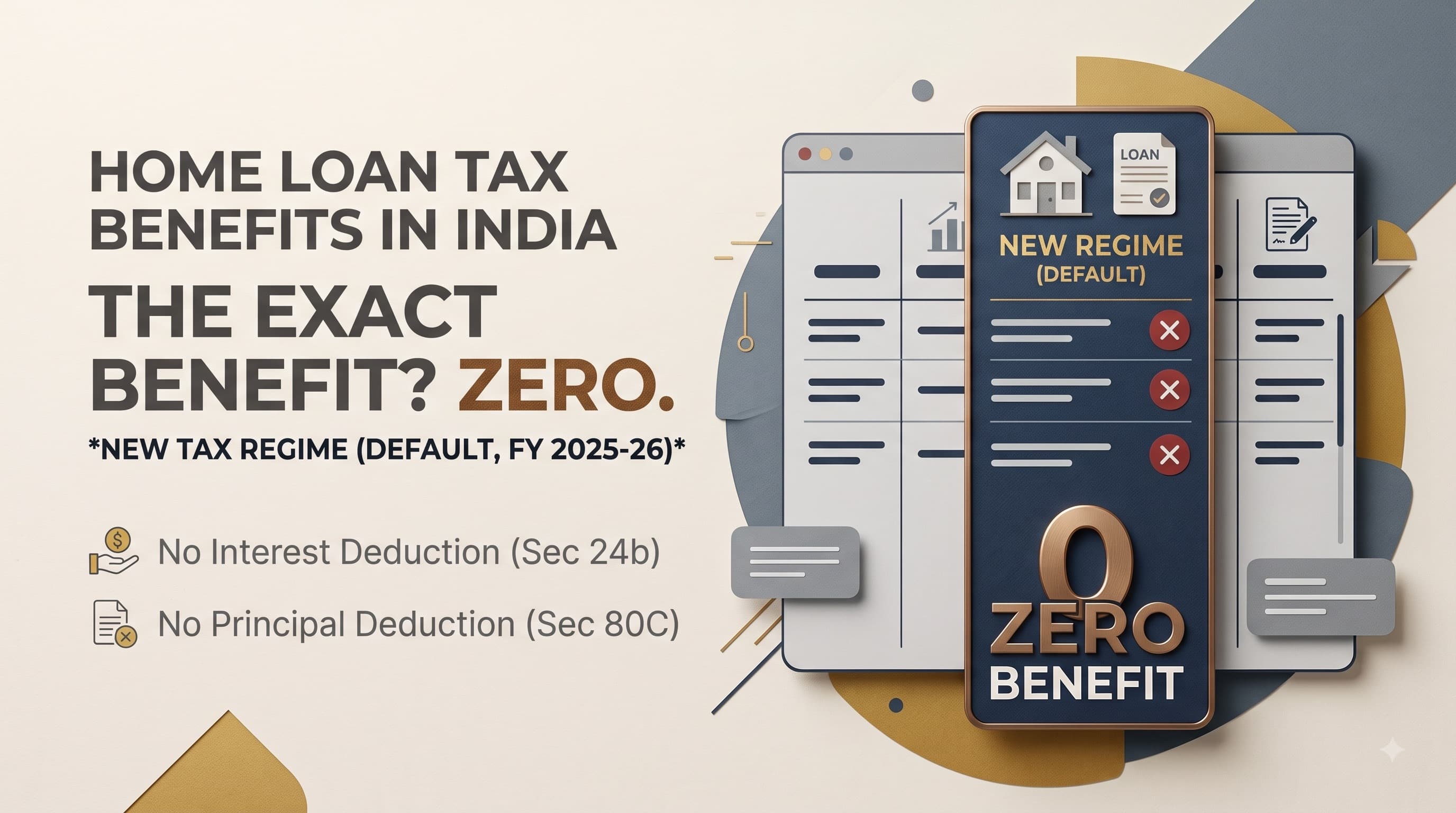
Home Loan Tax Benefits in 2026: What the New Regime Killed
Section 24(b), 80C and the new tax regime: which home loan tax benefits survive in FY 2025-26 and FY 2026-27, with the break-even math banks won't show you.

Contents
Most of what the internet tells you about home loan tax benefits is true — and obsolete. The articles ranking at the top of Google still walk you through Section 24(b)'s ₹2 lakh interest deduction and Section 80C's ₹1.5 lakh principal deduction as if every borrower gets them. Here is what those articles skip: if you file under the new tax regime — the default, and the mathematically better choice for most salaried Indians since the 2025 rebate changes — your self-occupied home loan gives you a tax benefit of exactly zero.
Not reduced. Zero. No interest deduction, no principal deduction, no stamp duty deduction. The entire architecture of "home loans save tax," built over two decades of financial content and repeated by every loan officer closing a sale, now applies only to the shrinking minority of taxpayers for whom the old regime still wins.
This matters beyond filing season, because "think of the tax saving" is still deployed as a reason to take a bigger loan, to not prepay, and to not refinance. Whether that argument holds for you is now a calculation, not a slogan. This guide runs the calculation — what survives in each regime as of FY 2025-26 and FY 2026-27, the break-even that decides your regime, and the special cases (joint loans, let-out property, under-construction homes) where real money still hides.
The scorecard: what survives where
| Benefit | Old regime | New regime (default) |
|---|---|---|
| Interest on self-occupied home — Section 24(b), up to ₹2,00,000/yr | Yes | No |
| Principal repayment — Section 80C, up to ₹1,50,000/yr | Yes | No |
| Stamp duty & registration — within 80C, year of payment | Yes | No |
| Interest on a let-out (rented) property — against rental income, no cap | Yes | Yes |
| 30% standard deduction on rental income | Yes | Yes |
| Set-off of house property loss against salary (up to ₹2,00,000/yr) | Yes | No |
| Extra interest under 80EE / 80EEA (legacy loans only) | Yes | No |
Two structural takeaways. In the new regime, a home you live in is tax-invisible: the loan behind it earns you nothing. A home you rent out keeps its main benefit — loan interest still deducts against the rent, uncapped, in both regimes. The tax code, post-2020, rewards housing as an income-producing asset and has stopped rewarding it as a residence.
The break-even: does the old regime still make sense for you?
The only reason to care about 24(b) and 80C in 2026 is if you file under the old regime. So the real question is upstream: which regime wins for you?
The new regime's slabs for FY 2025-26 and FY 2026-27 are materially friendlier — nil tax up to ₹12 lakh of taxable income via the Section 87A rebate (about ₹12.75 lakh gross for salaried, after the ₹75,000 standard deduction), and lower rates through the middle slabs. The old regime's slabs are unchanged and harsher, but allow the full deduction stack: home loan interest, 80C, HRA, 80D, NPS.
We computed the break-even — the total deductions (beyond the standard deduction) you need for the old regime to merely tie the new one:
| Gross salary | Deductions needed for old regime to win |
|---|---|
| ₹12.75 lakh or below | Effectively impossible — new regime tax is already nil |
| ₹15 lakh | ~₹5.4 lakh |
| ₹20 lakh | ~₹7.1 lakh |
| ₹24 lakh | ~₹7.9 lakh |
| ₹30 lakh+ | ~₹8.0 lakh |
Read that table against the maximum home-loan stack: ₹2 lakh of 24(b) interest plus ₹1.5 lakh of 80C is ₹3.5 lakh — less than half the break-even at every income level. The home loan alone can no longer carry you into the old regime. It only tips the scales when stacked with substantial HRA, 80D, NPS contributions, or a let-out property loss. That's not nobody — a ₹25 lakh earner paying metro rent with a family health policy and NPS can clear ₹8 lakh of deductions — but it's a specific taxpayer, not the average one.
Run your own numbers rather than assuming either way — the comparison takes two minutes:
If you do file old regime: the full toolkit, with real numbers
Take the standard case from our EMI guide: ₹50 lakh loan, 8.5%, 20 years. EMI ₹43,391. In year one you pay about ₹4.21 lakh of interest and ₹1 lakh of principal.
- Section 24(b) lets you deduct interest on a self-occupied home up to ₹2 lakh a year. At the 30% slab (31.2% with cess), that's worth ₹62,400 a year. Note what the cap does: ₹2.21 lakh of your year-one interest earns nothing. The cap hasn't moved since 2014 while loan sizes have doubled — an unindexed ceiling quietly shrinking in real terms.
- Section 80C covers the ₹1 lakh of principal — worth up to ₹31,000 — but the ₹1.5 lakh 80C bucket is shared with EPF, insurance premiums, ELSS and children's fees. For most salaried borrowers, EPF alone nearly fills it; the principal deduction is often worth little incrementally. Claim it, but don't count it twice.
- Stamp duty and registration fit in 80C too, in the year of payment only — same crowded bucket, and covered in detail in our stamp duty guide.
- 80EE / 80EEA: closed to new loans since 2017 and 2022 respectively. If your loan was sanctioned in the 80EEA window (April 2019–March 2022, stamp value ≤ ₹45 lakh, first home), you can still claim the extra ₹1.5 lakh of interest — old regime only. Worth checking your sanction date; borrowers forget this one.
Ceiling on the whole exercise: roughly ₹93,000–1.09 lakh a year of tax saved for a 30%-slab borrower using 24(b) fully and having genuine spare 80C room. Real money — but note it's about 2.2% of the loan outstanding, against an interest cost of 8.5%. Which sets up the point this whole guide exists to make.
Four situations where the rules get interesting
Joint loans: the one genuinely underused structure. Each co-borrower who is also a co-owner and actually pays EMIs gets their own limits: up to ₹2 lakh of 24(b) and ₹1.5 lakh of 80C each, interest split in ownership ratio. A working couple filing old regime can shelter up to ₹7 lakh a year between them — double a single borrower — and clearing the old-regime break-even becomes realistic for both. The conditions are strict, though: a spouse who co-signed the loan but isn't on the title deed gets nothing; a co-owner who doesn't service EMIs from their own income gets nothing. Structure this at purchase — ownership shares, loan parties, and who pays from which account — not at filing time.
Let-out property: the benefit that survived. Rent out the home and the loan interest deducts against rental income without cap, in both regimes — after the 30% standard deduction on the rent. On a ₹50 lakh loan with ₹25,000/month rent, year-one interest of ₹4.2 lakh fully wipes out the ~₹2 lakh of taxable rent — worth about ₹63,000 at the top slab even in the new regime. The regimes diverge on the excess loss: the old regime lets up to ₹2 lakh of it offset your salary; the new regime strands it. If you own a leveraged second property that's rented out, that stranded-loss difference is often what finally justifies the old regime.
Under-construction homes: a real trap, sharpened by delay. Interest paid before the year of possession isn't lost — it accumulates as "pre-construction interest," claimable in five equal instalments from possession, but within the ₹2 lakh self-occupied cap alongside your regular interest. The trap: if construction isn't completed within five years from the end of the financial year the loan was taken, the self-occupied cap collapses from ₹2 lakh to ₹30,000. A delayed project doesn't just delay your possession; it can gut your deduction for the life of the loan. (One thing that didn't change: Budget 2026 expressly preserved pre-construction interest treatment under the new Income-tax Act that took effect this April — the sections got renumbered, the substance carried over.)
Selling within five years: the clawback nobody mentions. Sell the house within five years of the end of the FY you took possession, and every rupee of 80C principal and stamp duty you claimed gets added back to your income in the year of sale. The interest deductions are safe; the 80C ones reverse. If an early sale is plausible, weight the 80C benefit at less than face value when you're deciding anything based on it.
The argument this should end
"Don't prepay / don't refinance — you'll lose the tax benefit" was always a half-truth. Now it's usually a zero-truth.
Under the new regime, for a self-occupied home, there is no tax benefit to lose. Every argument for keeping an expensive loan alive for tax reasons evaporates. A balance transfer that cuts your rate from 9.2% to 8.2% saves lakhs, and costs you nothing in deductions you weren't getting anyway. Prepayment returns you your loan rate, tax-free, risk-free.
Even under the old regime, the arithmetic was never close for most borrowers. The maximum saving — ₹62,400 on ₹2 lakh of interest — means the taxman refunds you at most 31% of a cost you're paying 100% of, and only on the first ₹2 lakh. Nobody should pay ₹4.2 lakh of interest to save ₹62,000 of tax if a cheaper loan or a prepayment is available. The tax benefit is a consolation on interest you'd pay anyway — it was never a reason to pay more interest, and loan officers who imply otherwise are selling, not advising.
Size the actual benefit for your loan, your regime, your slab — then make the loan decision on the loan's merits:
Where Ekatra fits
The regime question and the loan question interact, and almost nobody prices them together. A borrower who switches to the new regime frees themselves to refinance or prepay aggressively with no tax side-effects; a couple structuring a joint loan properly can make the old regime work when neither could alone. When we audit a household's loan, the tax position is part of the diagnostic — not because we file your returns, but because "what does this loan really cost after tax, in your regime" is the number every decision should run on. The audit is free, and commission-free — start here. For the regime choice itself and edge cases in your return, a CA who can see your full financial picture is the right final word.
Frequently asked questions
Can I claim home loan tax benefits under the new tax regime?
For a self-occupied home: no — neither the 24(b) interest deduction nor 80C principal. For a let-out property: yes — interest deducts against rental income (after the 30% standard deduction), though excess loss can't offset your salary in the new regime.
What is the maximum home loan tax benefit in FY 2025-26?
Old regime, self-occupied: ₹2 lakh interest (24b) + ₹1.5 lakh principal (80C) = ₹3.5 lakh of deductions, worth up to ~₹1.09 lakh at the top slab. Double for a properly structured joint loan. New regime, self-occupied: nil.
Can both husband and wife claim home loan tax benefits?
Yes — if both are co-owners on the deed, co-borrowers on the loan, and both actually service EMIs. Each then gets independent ₹2 lakh + ₹1.5 lakh limits, with interest split in ownership ratio. Miss any of the three conditions and that person claims nothing.
Do I lose tax benefits if I do a balance transfer?
No. Interest paid to the new lender qualifies under 24(b) exactly as before — the deduction follows the loan's purpose, not the lender. Under the new regime there's nothing to lose in the first place. Tax is not a reason to stay on an expensive loan.
What happens to tax benefits if my builder delays possession beyond 5 years?
For a self-occupied home, your interest deduction cap falls from ₹2 lakh to ₹30,000 a year — permanently, for that loan. Pre-construction interest also remains claimable only within that shrunken cap. It's one more reason project-completion risk is financial risk, not just inconvenience.
Is home loan interest deductible on a second home?
You can treat up to two homes as self-occupied (nil rent imputed). Old regime: the ₹2 lakh interest cap applies across both combined. New regime: no deduction for either. If the second home is rented out, interest deducts against the rent in both regimes.
Related reading
- Stamp Duty & Registration Charges in 2026, City by City
- How to Actually Reduce Your Home Loan EMI
- The Complete Guide to Home Loan Balance Transfer in India
- The Complete Home Loan Guide for India in 2026
- The Home Loan Glossary: every term, in plain language
Ekatra is a free, AI-native home loan management platform built for India's middle-class borrowers. We don't take commissions from lenders — which is why we can tell you when the tax benefit is real and when it's a sales line. This article is general information, not tax advice; confirm your regime choice and filings with a chartered accountant. Visit joinekatra.com to start the diagnostic for your loan.

Written by
Prannay KediaThe founder of Ekatra, he previously worked at Bain & Company and the Bombay Stock Exchange, holds an MBA from IIM Calcutta, and writes about money and music.